
Web data is the new source of truth driving the global economy. For the companies using it at the largest scale, that’s thanks to a new breed of data insights and engineering teams.
But what sets the best data teams apart from the rest is not just access; it’s an expert-level attention to the ongoing task of running a scaled data-gathering system.
That’s the difference between a team that keeps business-critical pipelines flowing and one that is scrabbling to stem the tide of silent data corruption.
So, on an average Tuesday afternoon, what does “amazing” look like in the very best data teams? We found the answer close-up, in real, observable behaviors practiced by Zyte customers. This is self-help for data leaders.
They treat data like a product, not a project
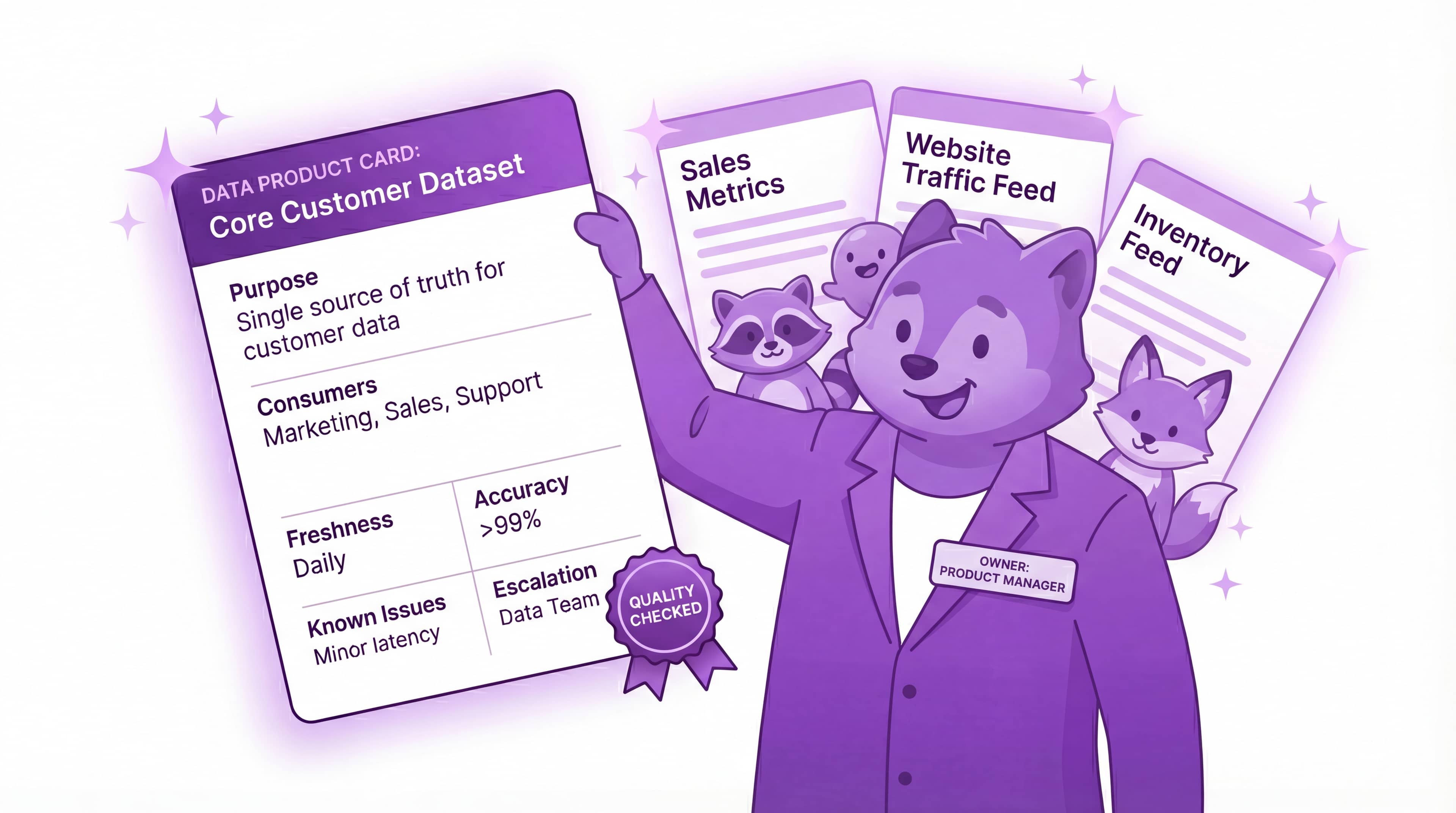
Often, data is the input to, or content of, a broader product offering. But data isn’t just an input. In a high-performing organization where data is a critical component, every significant data asset - a dataset, a metric layer, a data feed, a model feature store - has a named owner with a real roadmap.
When consumers of that data have questions or concerns, they know exactly where to go and they receive an accountable answer. The data team has the clarity and authority to say "no" to requests that would create orphaned, unmanaged dependencies. Work is not a reactive queue of one-off tickets; it is organized around a portfolio of enduring data products.
On the job
When a product manager asks for "just one more field" added to a core dataset, the data team's response is not to blindly execute. Instead, it asks questions like:
“How easy is this field to collect?”
"What decision will this new field enable?”
“Who will own the business definition?”
“What breaks if this field is wrong or becomes stale?"
“Are we actually ready to ingest the new field?”
That looks like obstruction, but it is also a fundamental tenet of product management.
At the scale of thousands of pipelines, the idea that work can be organized as a series of "projects" is, sadly, a fiction. No - you are running a tangible product surface, and every addition to it has a cost.
Do this now
Define three to five core data products. Give each an owner, a changelog, and a success metric tied to real-world usage and trust.
Introduce a one-page "data product card" for each source - a simple and durable artifact, listing the purpose, consumers, freshness and accuracy expectations, known failure modes, and escalation path.
They intuitively understand data ‘truth’

Monitoring for data-gathering throughput and accuracy has come a long way. But effective data teams don’t just leave it to the dashboards - they can explain precisely where a number comes from and, just as importantly, what could cause it to be wrong.
It’s the kind of habit that involves intuition. Don’t just monitor whether pipelines ran successfully; monitor for shifts in the meaning of the data - outliers, distribution shifts, sudden changes in volume, coverage shrinkage. For the metrics that truly matter, effective teams publish their confidence levels without drama, and they catch data drift before their stakeholders do.
On the job
A data leader looks at a report and might instinctively say: "These numbers feel wrong." Instead of a defensive scramble, the team presents a concise "truth packet" for the metric in question: its precise definition, its data lineage, the last known-good period, any known gaps or limitations, and the results of the latest quality checks. This transforms a potentially contentious situation into a productive investigation.
As one online intelligence platform recently told us: “We are spending more time on checking the quality of the data, comparing whether it's aligned with previous product count or not.”
There’s a cost to not doing this. Great Expectations documented a case of a retailer that had a product mistakenly priced at $1 million for an entire year. No automated check flagged the outlier and the pipeline never crashed. But the data was profoundly wrong, a "silent failure".
Do this now
For every KPI the business relies on, write a one-paragraph "what would make this wrong?" statement.
Then implement monitoring that tests the meaning of the data, not just the operational success of the pipeline. The goal is a system resilient to the silent, creeping decay of truth.
They design for decisions, not for data

Data is a resource, a means to an end. For effective data teams, the unit of value is not the dataset or the dashboard; it is the decision or outcome made possible by data.
Every key dataset is accompanied by a "decision map" that outlines:
Who uses the data.
For what specific call.
How frequently.
What the consequences are if the data is late or wrong.
The team's primary outputs are not dashboards for passive consumption. Rather, they are active decision tools, like:
Alerts that trigger action.
Thresholds that signal a change in status.
Review queues that surface items for human judgment.
Exception lists that highlight anomalies.
On the job
Some of the best data teams we have spoken with say they like metrics they can act on and which keep them informed - alerts and helpful visuals they can share with bosses and beyond.
So, instead of shipping "a competitor pricing dashboard”, the team ships a set of targeted tools, like:
Price-change alerts that notify the pricing team of significant market shifts.
A list of items requiring review where pricing may be misaligned.
For more advanced use cases, a recommended action with a confidence score and an explanation of the underlying rationale.
With outcome-oriented data thinking, the focus shifts from data presentation to decision enablement.
One Zyte retail customer says the data it collects is ingested into an internal analysis tool usable by everyone from an individual contributor (IC) employee, all the way up to the CEO..
In environments where data feeds proprietary research and risk analytics, this distinction is not subtle; vanity reporting has no place, and every output must be directly applicable to a decision being made.
Do this now
Know your customer. Understanding whether your internal data audience is in sales, marketing or another team is critical to building empathy; same goes for understanding the data’s destination - a Tableau visualization and an internal dashboard app are very different.
For each major stakeholder, document the moment of decision - the context in which they act and what "actionable" truly means for them.
Then, ruthlessly reduce the number of metrics shown and increase the number of actions enabled.
They run a tight ‘data incident’ practice

When a critical number is wrong, the response from an effective data team is boringly predictable and fast.
There is a well-defined process, a clear understanding of severity levels tied to business impact, and a culture of blameless post-mortems that produce concrete controls, not just apologies. The entire incident response is a calm, practiced ritual: contain the impact, communicate to stakeholders, correct the issue, prevent its recurrence.
On the job
A data incident may include collection failure due to a website design change, leading to missing data.
Containing the impact of an incorrect signal might mean flagging data as suspect, freezing a metric, or rolling back a change to stop bad numbers from propagating further. Communication is proactive, with clear schedules. The fix is followed by a post-mortem written to be understood across the organization, not just by the data team.
This is a direct adoption of the mature incident response culture established in software engineering:
As described in Google's SRE workbook, good post-mortems include a glossary for accessibility, thematically grouped action items, quantifiable metrics, and links to source data.
Atlassian's incident management guidance similarly emphasizes structured templates that cover the summary, the fault, and the supporting artifacts.
There is real applicability to data teams: as Datafold has argued, data quality failures are a species of production incident, and the same discipline that software teams use to prevent repeat outages can prevent repeat data errors.
Do this now
Create "data severity levels" based on the business decisions impacted, not on technical symptoms.
Implement a "suspect data" mechanism - including quality flags, a backfill process, and the ability to temporarily freeze a metric - so the organization can stop acting on bad numbers the moment they are discovered.
Then formally adopt the data quality post-mortem. This is the step that turns a reactive fire-drill into a learning process.
They keep the seam between engineering and analytics healthy

The boundaries between data collection, transformation, and the final metric are where meaning is often most easily lost. Think taxonomy changes, parsing logic updates, late-arriving data, and definition drift. Effective data organizations treat those boundaries as high-risk and instrument them accordingly.
Engineers are not penalized for adding provenance instrumentation, and analysts are not penalized for asking basic questions about where data comes from. The semantic layer - where raw data is translated into business concepts - is treated as real software: versioned, reviewed, and tested.
On the job
When a change is made in an upstream data source, the team ships a versioned change with clear release notes: what changed, who needs to be aware, how to interpret trends that cross the boundary of the change. This discipline ensures that semantic meaning is not lost in the gaps between systems.
One fintech company leaned on Zyte’s team to handle complex data targets, managing the seam between its own code and Zyte’s pipelines. Apparel companies and intelligence providers similarly mix internal and external pipelines, relying on clear seam definitions to avoid patchworks that “just happen”.
Consider an architecture where scraping does not parse HTML directly - that is, raw artifacts are stored and parsed later by separate transformers. It’s a valid design, but it creates a critical seam between the raw data and the structured output. Monitoring only whether the initial collection ran successfully misses the more important question: did the meaning of the data remain intact through the transformation?
Do this now
Place analytics definitions in code or versioned documents, subject to review.
Require a formal review process for changes that affect executive KPIs.
Implement seam checks that reconcile data across the key boundaries in your data flow, including sampling and comparing raw, canonical, and final metric forms.
Value your fields. Not all data points are equal. Borrow the playbook from Zyte customers that apply different collection “tolerance” values. For instance, two days without pricing data may cross your personal threshold.
They hire and reward for judgment, not just technical output

In the most effective data teams, the heroes are not the people who ship the most tables or build the most complex pipelines. They are the ones who prevent bad decisions.
Promotions reflect measurable improvements in the organization's trust in its data and reductions in decision latency, not just pipeline throughput. The team is valued for its judgment.
On the job
Imagine a senior team member finds themselves in an uncomfortable conversation with a stakeholder, having to say: "This metric, as currently defined, cannot support the decision you are trying to make." Or maybe they’re saying: "We need to slow down and agree on what reality we are measuring before we automate a response to it."
These are not conversations about technical feasibility; they are conversations about intellectual honesty and the responsible use of data.
If your pipeline has wrongly gathered an ecommerce listing with a $1 million pricepoint, maybe the failure was not a technical one; maybe it was a failure of incentive design. Nobody was rewarded for catching the obviously wrong thing early; the system was designed to reward output, not judgment.
Do this now
Add "decision impact" and "trust outcomes" to performance criteria.
Create career paths for "data product owner" and "data reliability engineer" roles that formally recognize the value of ownership and stewardship.
Reward the people who have the hard conversations.
Make it clear that the team's purpose is not to produce data, but to produce better decisions.
They build leverage: templates, primitives, and constraints

Effective data teams do not start from a blank slate on every new project. New data products are instantiated from a kit: think standard schemas, default QA checks, established ownership patterns, templated incident playbooks.
In this environment, the team has approved ways to accomplish common tasks, and this standardization saves months of redundant effort. They aggressively seek out and delete bespoke, one-off solutions that are destined to rot.
On the job
When a new request comes in, a team can respond with a clear estimate: "We can deliver this in two weeks because it fits our primitives." Alternatively, it can warn: "This is a custom snowflake, it will be expensive to build and a maintenance burden." Those kind of parameters support fast action, whether it means adding a new data feed or rejecting the request.
The ability to make that distinction cleanly is a hallmark of a mature data organization. The post-mortem template discussed earlier is itself a form of this leverage - it ensures that the quality of the incident response does not depend on individual heroics.
Do this now
Standardize your approaches to entity resolution, naming conventions, definition formats, your default monitoring suite, and your review process for new data products.
Create a "new metric / new dataset" checklist that forces the team to address ownership, definition, testing, and communication from the start. It is a paved road that makes it easy to do the right thing.
The work of alignment
Effective data teams are not necessarily the teams with the most data, the newest stack, or the flashiest dashboards.
They are the teams that can keep an organization aligned on reality as that reality changes. Their work is about producing trust.
If you want to begin building these habits, you do not need to overhaul everything at once. Pick one mission-critical metric or data feed and implement four things: an owner, a truth packet, three meaning-based checks, and a lightweight incident and postmortem ritual.
That is how you can make the machine safer, without waiting for it to crash.