





Job listing data

Job posting data from any source, delivered ready to use

Structured job listings from job boards, aggregators, recruitment portals, niche sites, and company career pages, collected at the scale, cadence, and schema your team needs.

The basics

What is job posting data?

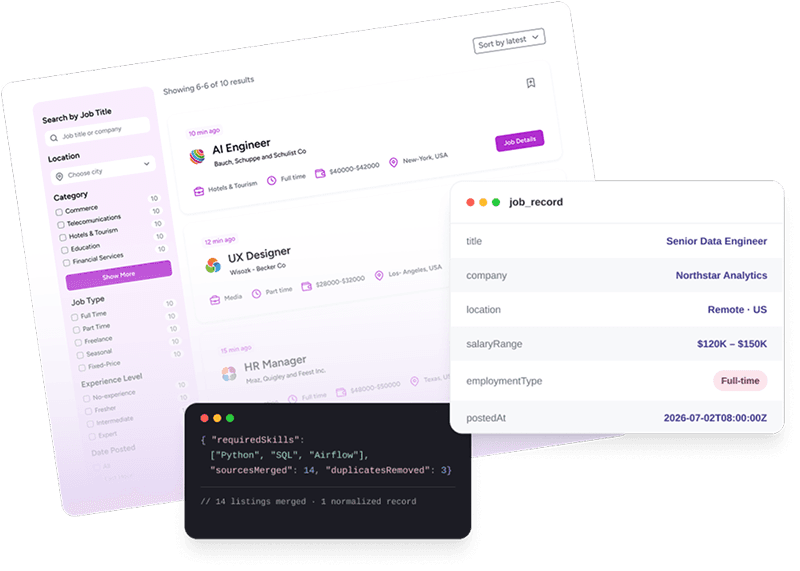
Job posting data is a structured, normalized record of a job ad (title, company, description, location, salary, employment type, skills, and metadata) pulled from job boards, career pages, and recruitment sites. Because the same role often appears differently across dozens of sites, the value lies in that normalization: one clean record per job, regardless of source. Job postings are among the clearest public signals of what employers need right now, making this data valuable for labor-market analytics, salary benchmarking, talent intelligence, hiring analysis, AI products, and investment research, but only when it's fresh, structured, and reliable.
Who uses it

Use cases across industries

The same data type, put to work differently. Ordered by how directly it applies.

Salary benchmarking and wage trends

HR and compensation teams monitor advertised salary bands across markets, regions, and competitors to inform hiring budgets and pay bands. Tracked over time, job posting data reveals how wages are moving before survey data catches up.
Labor-market analytics platforms

Analytics platforms, government agencies, and education providers use job posting data to measure demand for skills, track regional hiring trends, build workforce dashboards, and power economic research — from total open roles to seniority mix and emerging skill requirements.

Competitive intelligence

Teams track where rivals are hiring — which functions they're growing, what skills they're prioritizing, and how fast they're scaling — as an early signal of strategic direction. Job postings reveal intent before press releases do.

Job boards and aggregators

Recruiting platforms and job aggregators collect postings from across the web to build comprehensive listings databases. Zyte handles the extraction and normalization so engineering teams can focus on product instead of parser maintenance.

Remote, hybrid, and RTO trend tracking

Job ads are one of the most consistent public records of what employers actually expect around location. Tracked over time and across markets, they show how workforce policies are shifting — faster and more precisely than surveys.

Investment and market research

Hiring patterns are a leading indicator of company growth, strategic bets, and competitive positioning. Investors and market researchers use job posting data to track headcount signals across companies, sectors, and geographies.

AI and search products

AI search engines, career assistants, and model training datasets need clean, structured job posting data at scale. Zyte provides both the extraction pipeline and the semantic normalization needed to make raw job ads useful for AI-powered products.
The hard part

Why job listing data is hard at scale

The problem is rarely a single job page. It's keeping millions of them flowing correctly while the sites underneath keep changing, and the listings themselves keep expiring.

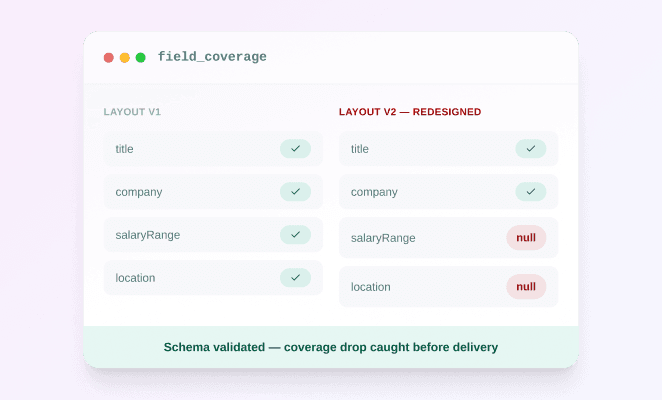
Site redesigns break parsers overnight

Job boards frequently update their layouts, and HTML parsers silently drop fields when they do. Salary returns null. Location disappears. The dashboard still looks clean. Zyte validates every feed run against your agreed schema so coverage drops are caught before they reach your product.

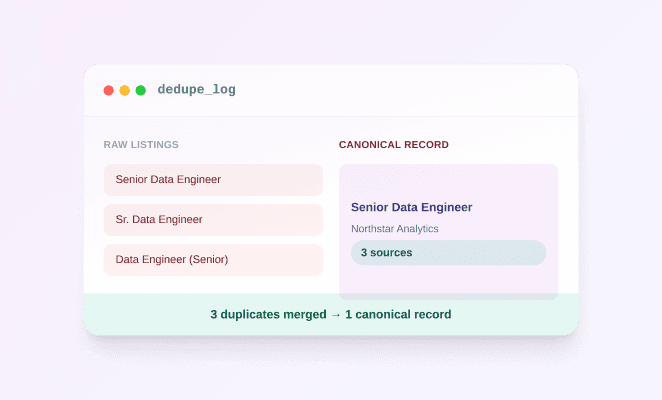
Duplicate listings inflate every count

The same role is routinely posted to dozens of boards under slightly different titles and formats. Without deduplication and normalization, any count of open roles or salary average is already wrong. Zyte resolves listings across sources into one canonical record per job.

Listings expire fast: freshness is everything

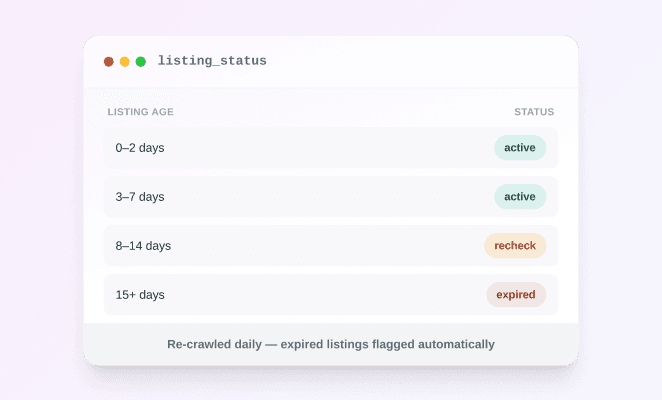
Job postings have short lifespans. Stale listings corrupt salary benchmarks, inflate open-role counts, and mislead analytics. Zyte re-crawls sources at the cadence your use case requires (from daily to near-real-time) and tracks active versus expired status per listing.

Major job boards actively block collection

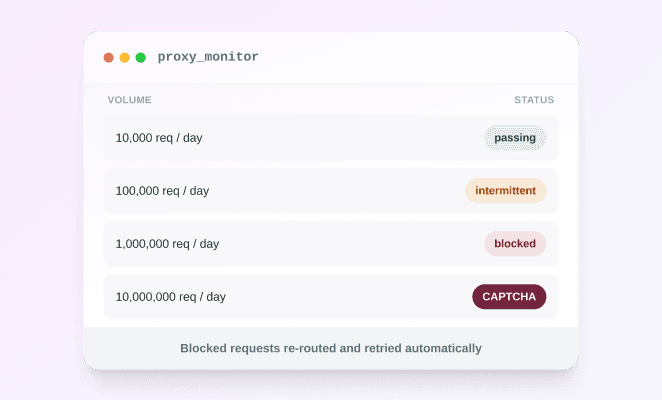
Major job boards and others use AJAX-heavy pages, infinite scroll, rate limiting, and fingerprinting to block automated collection. Parsing raw HTML isn't enough. When a request is blocked, Zyte re-routes and retries automatically, and persistent blocks are escalated to the team running your feed.

Sources differ in fields, formats, and quality

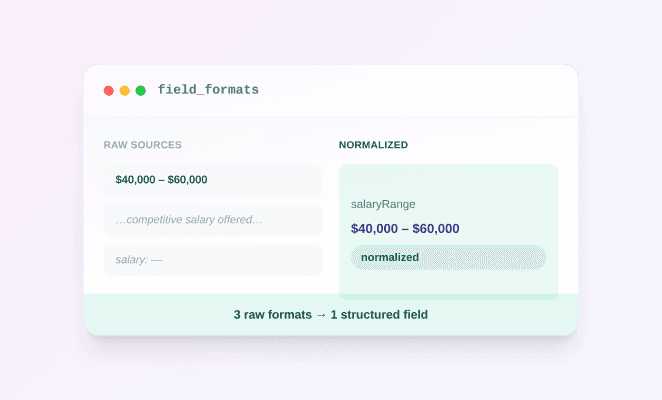
One board publishes salary as a range. Another buries it in the job description. A third omits it entirely. Zyte's AI extraction goes beyond HTML parsing to capture structured fields even when they're unstructured, inconsistent, or rendered client-side.

What Zyte extracts

Custom schemas are available. Zyte can map extracted fields to your own data model and deliver in the format your team uses — CSV, JSON, Excel, or API feed.

Coverage

The cost of getting it wrong

What bad training data quietly costs the model

Bad web data does not announce itself. It shows up later, in a model that underperforms on a benchmark that should have been easy.
Model quality
2–4 wks
A model retrained on a gappy or drifted feed degrades for weeks before anyone traces it back to the data.
Engineering cost
5 engineers
Teams that retire their in-house scraping stack redirect multiple senior engineers back to building product instead of babysitting pipelines.
Compliance exposure
€35M
The EU AI Act, in force from August 2026, carries penalties of up to €35M or 7% of global turnover for non-compliant AI training data use.
Provenance gaps
1 in 3
AI procurement reviews stall or fail when teams cannot document where training data came from and how it was collected.
Reviews

What our users say

I have been working with Zyte's team for the last few months, and their team is fantastic. I appreciate their development speed and quality, and they run a very robust platform, producing very satisfactory results. I love the ease of the initial setup with Zyte, as they took care of all the development, and we only needed to communicate what data we needed and set up the necessary processes on our end.

David P.

Get a job posting data feed scoped to your sources

Talk to a data specialist about coverage and schema, or request sample data for a source you care about.

Frequently asked questions

What types of AI use cases does Zyte support?

Zyte supports training and pre-training dataset builds, fine-tuning and domain adaptation corpora, RAG knowledge base pipelines, evaluation set construction, and web access for AI agents. Continuously refreshed pipelines are available.

How do you handle data provenance for AI compliance?

Every dataset Zyte delivers includes documented sourcing — the origin URLs, collection method, extraction date, and schema version. This gives AI teams the audit trail needed for enterprise procurement reviews and, where applicable, EU AI Act compliance documentation.

What formats and delivery methods do you support?

Zyte delivers data in JSONL, Parquet, CSV, and custom formats, via S3, SFTP, API, or direct warehouse integration. Format and delivery cadence are scoped per project.

How fresh can AI training data be?

For continuously refreshed pipelines, cadence is defined per source based on how frequently that source actually changes. News and forum content can be refreshed daily or intraday; broader web corpora are typically refreshed on a weekly or monthly schedule.

How do you approach compliance for AI training data?

Zyte collects only publicly accessible content and applies opt-out signal detection, copyright flagging, and personal data filtering. For enterprise customers and those subject to the EU AI Act, Zyte provides written documentation of collection methodology and governance controls.

Can Zyte build a custom schema for my model's input format?

Yes. Zyte Data projects are scoped to your schema — you define the fields, structure, and normalisation logic. Standard schemas are available as a starting point for common content types like articles, products, and job postings.

How long does setup take?

A scoped dataset with a defined schema and source list typically takes two to four weeks from kickoff to first delivery. Timelines vary with source complexity and volume.

Can I see a sample before committing?

Yes. Talk to a data specialist to request sample data from the sources you care about before agreeing to a contract.