Social media data

Social media web data, delivered to spec

Production-grade social data: posts, profiles, engagement, and public group activity, normalized and delivered. Build it yourself on Zyte API, or have it delivered to spec by Zyte Data. Same foundation, your choice of who runs the pipeline.

The basics

What is social media web data?

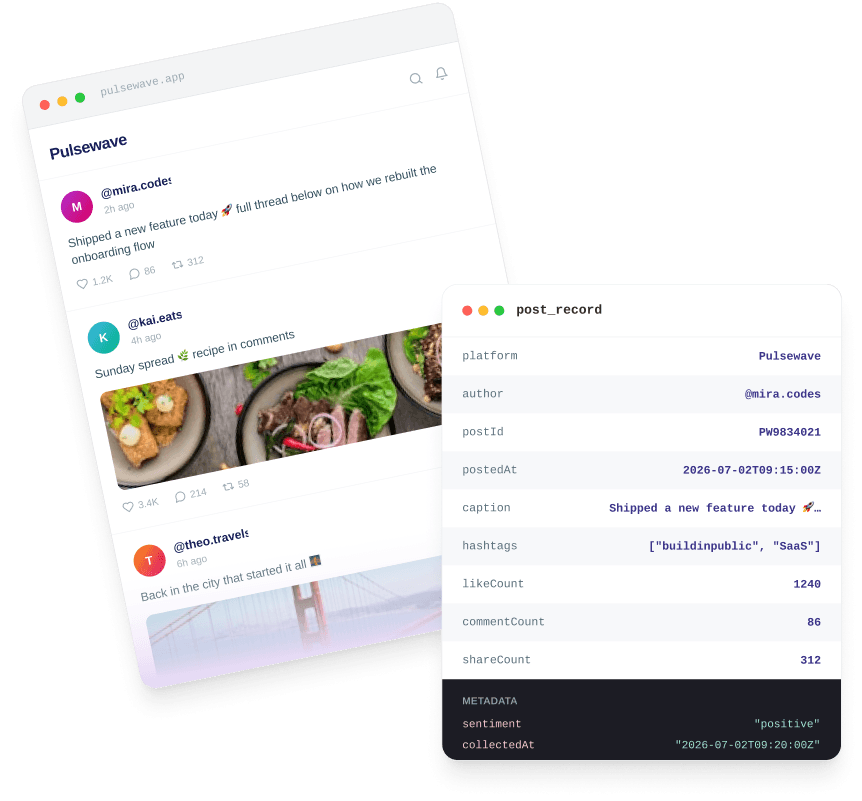
Social media data is the structured record of public activity on a platform: posts, profiles, engagement, and the language people use around a brand or topic. It's collected from public pages and feeds across networks and forums, then normalized into a consistent schema. Because the same conversation looks different on every platform, the value is in the normalization, not the raw post.
Who uses it

Use cases across industries

The same data type, put to work differently. Ordered by how directly it applies.

Brand & marketing teams

Track mentions, sentiment, and campaign reach across every platform your audience uses. Mentions surfaced within hours
Trust & safety, policy teams

Monitor public discourse to spot coordinated activity and disinformation early. Coverage across mainstream and niche platforms

Market research & investment

Social signals as an early read on demand, sentiment, and emerging trends. Used as a leading indicator

Talent & influencer platforms

Profile and engagement data to vet creators and verify real reach. Engagement verified, not self-reported

Local & business intelligence

Surface business details small companies only list on their social profiles. Location data for 50K+ businesses

Consultancies & agencies

Market-wide sentiment studies without standing up scraping in-house. Project-scoped feeds delivered in weeks
The hard part

Why social media data is hard at scale

The problem is rarely a single profile. It's keeping thousands of feeds flowing, correctly, while platforms actively work to stop you.

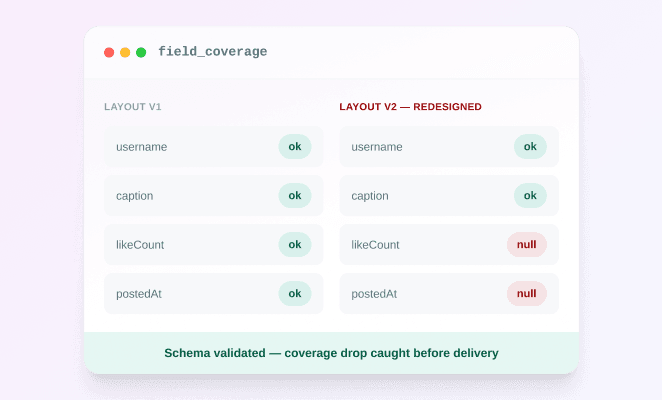
Platforms change layouts overnight

Zyte validates every feed run against your agreed schema.

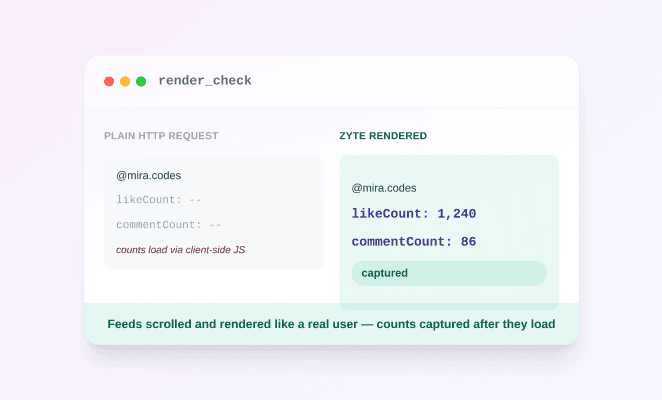
Engagement renders dynamically

Zyte scrolls and renders feeds the way a real user does, so like and comment counts are captured after they load, not before.

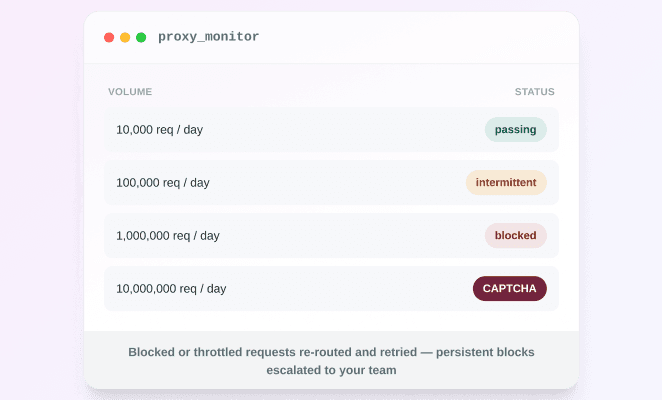
Anti-bot and rate limits are aggressive

When a request is blocked or throttled, Zyte automatically re-routes and retries with a different approach, and persistent blocks escalate to the team running your feed.

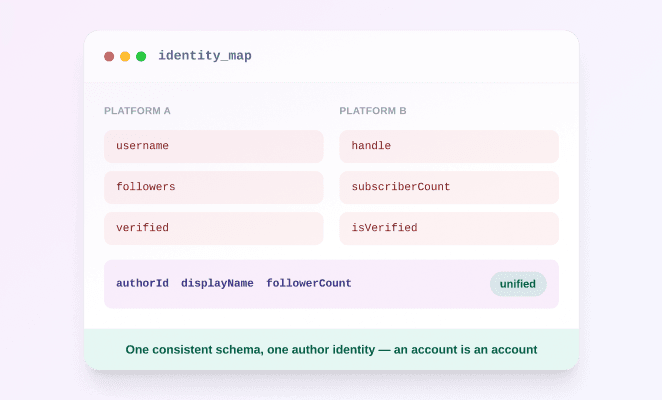
Schemas fragment across platforms

Zyte resolves each source into one consistent schema and one author identity, so an account is an account no matter which platform it's on.

Full history sits behind gates

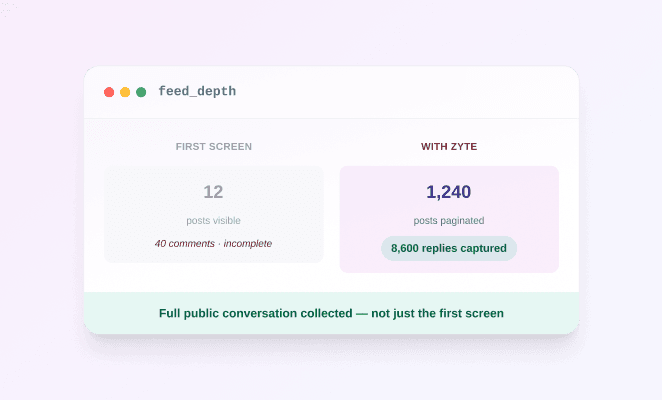
Zyte collects what's public — paginating posts, comments, and replies — so the feed reflects the full public conversation, not just the first screen.

Feeds are region- and session-personalized

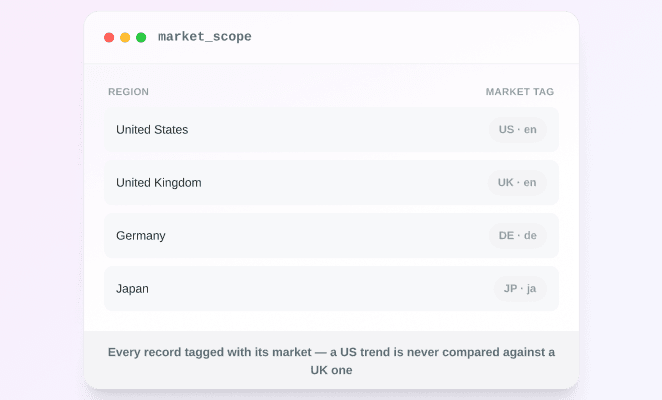
Zyte collects each feed from the region and context you specify, and tags every record with the market it belongs to, so a US trend is never silently compared against a UK one.
The cost of getting it wrong

Bad data doesn't fail loudly, it just costs you

Bad web data doesn't announce itself — it shows up later, in a valuation or offer made on a number that was already wrong.
Crisis response
6 hrs
Average lag between a PR crisis mention and detection when monitoring only top posts — coordinated backlash often builds during that gap.
Coverage integrity
1 in 5
A quiet outage on one platform hides one in five relevant mentions — dashboards still look complete.
Model drift
3–5 days
A sentiment model trained on a stale feed drifts for days before anyone notices the shift.
Regulatory exposure
€20M
Scraping personal data or bypassing login walls risks GDPR penalties up to €20M. Public-only collection keeps you clear.

See the Schema

The request you send and the data that comes back. Pick the standard schema or a custom one mapped to your model, and read the response as a table or JSON.

Zyte API
REQUEST
POST https://api.zyte.com/v1/extract

{
  "url": "https://looply.com/p/CxYz123AbC",
  "socialMediaPost": true
}
RESPONSE
Standard social media schema
Field
Type
Example
url
string
https://looply.com/p/CxYz123AbC [http://looply.com/p/CxYz123AbC]
platform
string
Looply
postId
string
CxYz123AbC
author
object
{ ... }
author
object
{ ... }
name
string
Jordan Lee
handle
string
@jordanlee.creates
followers
number
48200
name
string
Jordan Lee
caption
string
Sunset over the harbor tonight 🌅 #travel #photography
likes
number
3820
comments
number
142
shares
number
56
hashtags
array
["travel", "photography", "sunset"]
mediaUrls
array
["https://looply.com/media/img1.jpg [https://looply.com/media/img1.jpg]"]
postedAt
string
2026-08-10T18:32:00Z
engagementRate
number
4.7
Reviews

What our users say

I have been working with Zyte's team for the last few months, and their team is fantastic. I appreciate their development speed and quality, and they run a very robust platform, producing very satisfactory results. I love the ease of the initial setup with Zyte, as they took care of all the development, and we only needed to communicate what data we needed and set up the necessary processes on our end.

David P.

Get a social data feed scoped to your platforms

Talk to a data specialist about coverage and schema, or request sample data for a platform you care about.

Frequently asked questions

How fresh can social media data be?

Posts and engagement metrics are typically delivered daily or several times a day; full profile and bio attributes are usually re-crawled weekly. Real-time and on-event delivery — for breaking mentions or crisis monitoring — is available where a use case needs it. We scope frequency per platform to how often that platform's content actually changes.

How do you handle platform changes that break extraction?

Social platforms redesign feeds, change DOM structure, and roll out A/B-tested layouts constantly, often without notice. Zyte validates every feed run against your agreed schema, so a broken field is caught and fixed before it reaches you, not after. If a platform ships a structural change, our team patches the extractor and backfills any gap — you're not the one who finds out a field went null.

What about anti-bot measures, rate limits, and logins?

Social platforms run some of the most aggressive anti-bot defenses on the web — rate limits, device fingerprinting, login walls, and rotating challenge pages. When a request is blocked or throttled, Zyte automatically re-routes and retries with a different approach in real time. Persistent or platform-wide blocks escalate to the team running your feed, so recovery doesn't wait on you noticing a gap in your data.

What formats and delivery methods do you support?

Data is delivered as JSON or CSV, via S3, GCS, direct API pull, or a scheduled push to an endpoint you control. Feeds can run on a fixed schedule, on-demand, or on-event (e.g., a spike in mentions). Custom schemas are supported if you need fields mapped to your existing data model rather than our standard schema.

How do you approach compliance for social data?

We collect public data only — no PII beyond what a platform surfaces to any logged-out visitor, and no behind-login or gated content. Every source is reviewed against the platform's terms and applicable data protection law (GDPR, CCPA) before it's added to a feed, and that review is revisited if a platform's terms change. If a use case requires anything beyond public data, we'll tell you it's out of scope rather than build it anyway.

How long does setup take?

For platforms we already cover, a new feed can typically go live within days. For a new platform or a highly customized schema, initial setup usually takes 1–3 weeks, including a sample delivery for you to validate before the feed goes live on a schedule.

What does a social media data feed cost?

Pricing depends on platform difficulty, post volume, crawl frequency, and schema complexity — a daily feed of public brand mentions costs less than a real-time, high-volume feed across multiple platforms with full comment threads. Plans start from $450/month; we'll scope an exact quote once we know your sources and cadence.

Can I see a sample before committing?

Yes. If we already cover the platform you need, we can share sample records right away. For a new platform, we'll deliver a sample following development kickoff, before you commit to a full feed — so you can validate schema and coverage against real data first.