Proptech & listing platforms
Aggregating and normalizing listings across portals to power search and discovery.
- Daily sync across 100+ listing sources
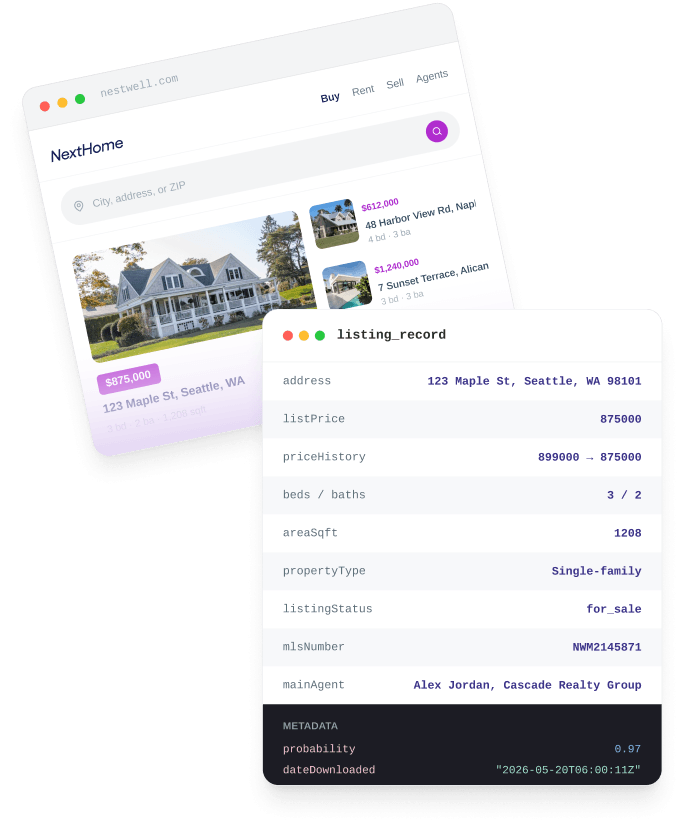
Production-grade listing data: composable, not packaged. Build it yourself on Zyte API, or have it delivered to spec by Zyte Data. Same foundation, your choice of who runs the pipeline.


Real estate data is the structured record of a property as it's listed for sale or rent online: its address, price, specs, media, status and the agent or office behind it. It's collected from public listing pages across portals, brokerage sites, and agent directories, then normalized into a consistent schema. Because the same property can appear differently on every site, and its price and status change constantly, the value is in keeping that record accurate and current, not in the raw page.
The same data type, put to work differently.
Aggregating and normalizing listings across portals to power search and discovery.
Comparable listings and price history feeding automated valuation models (AVMs).
Price trends, vacancy rates, and market direction as signals for underwriting and acquisition.
Rent pricing and availability tracking across competing listings for dynamic pricing.
Office and agent roster data for lead generation and territory mapping.
Market-wide listing studies without standing up scraping infrastructure in-house.
The problem is rarely a single listing. It's keeping thousands of them flowing, correctly, while the sites underneath keep changing.
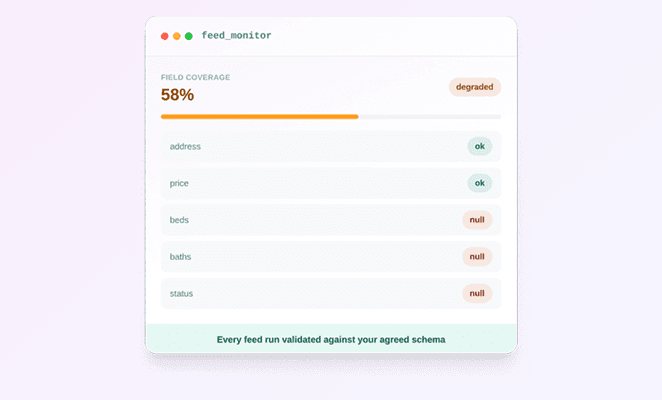
Zyte validates every feed run against your agreed schema.
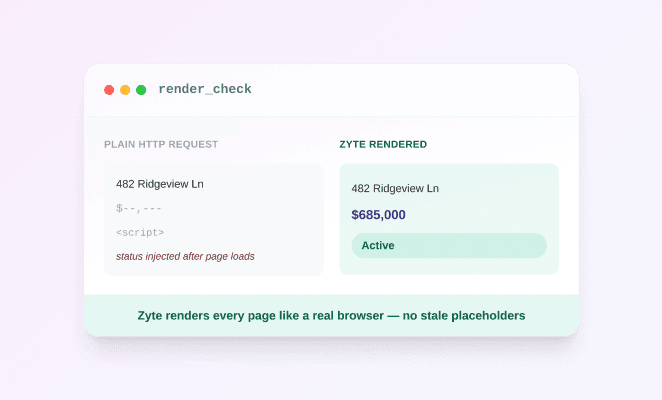
Zyte renders pages the way a real browser does, so client-side price and status changes are captured reliably — not a stale placeholder.
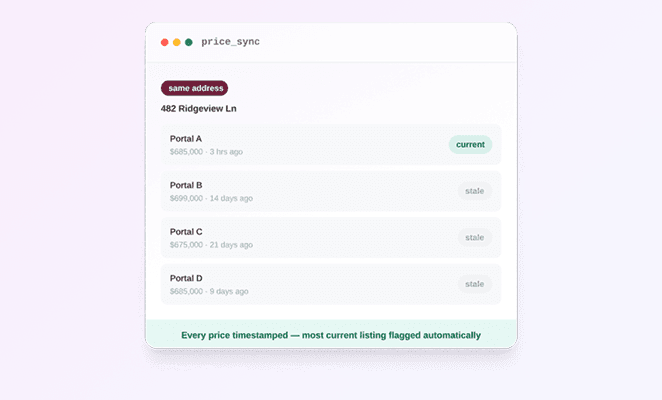
Zyte timestamps every price it collects and flags which listing is most current, so a stale syndicated price is never mistaken for today's.
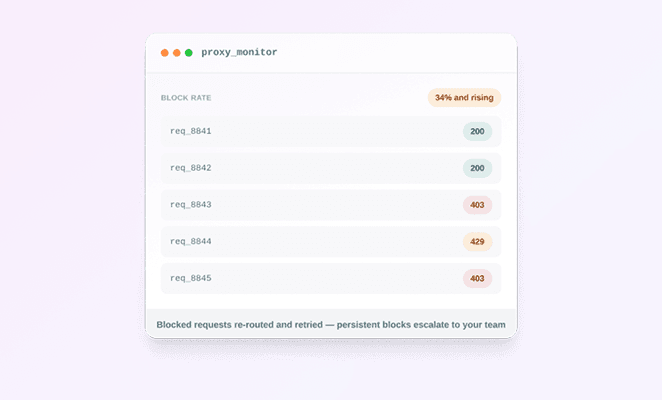
When a request is blocked, Zyte automatically re-routes and retries with a different approach, and persistent blocks escalate to the team running your feed.
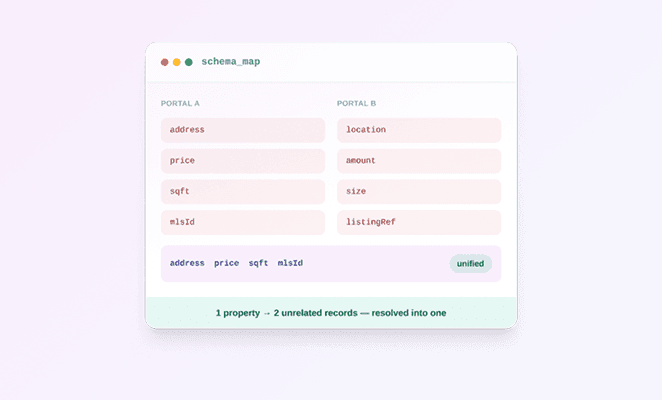
Zyte resolves each source into one consistent schema, so a listing is a listing no matter how many portals it came from.
Bad web data doesn't announce itself — it shows up later, in a valuation or offer made on a number that was already wrong.

Value a property against week-old comps and roughly a quarter of your estimates are already off.
A silent coverage drop hides one in eight listings — dashboards still look complete.

An AVM retrained on a gappy feed drifts for weeks before anyone traces the cause.

Collecting personal agent data or ignoring site terms risks GDPR penalties up to €20M.
The request you send and the data that comes back. Pick the standard schema or a custom one mapped to your model, and read the response as a table or JSON.
POST https://api.zyte.com/v1/extract

{
  "url": "https://example-portal.com/listing/12345",
  "product": false,
  "realEstate": true
}Reliable Competitor Data Partner with Stellar Support
I have been working with Zyte's team for the last few months, and their team is fantastic. I appreciate their development speed and quality, and they run a very robust platform, producing very satisfactory results. I love the ease of the initial setup with Zyte, as they took care of all the development, and we only needed to communicate what data we needed and set up the necessary processes on our end.
Price and status are typically delivered daily or several times a day; full listing attributes are usually re-crawled weekly. Real-time and on-event delivery is available where a use case needs it. We scope frequency per portal to how often that site actually changes.
Every feed run is validated against your agreed schema, so a layout change on the source site surfaces as a coverage alert — not a silent gap in your data.
Zyte's infrastructure re-routes and retries automatically when a request is blocked, adapting to each portal's defenses without you managing proxies or headless browsers.
JSON Lines and CSV are standard, with separate files for offices and agents when a project involves directory or roster data. Delivery via S3, GCS, SFTP, or API pull, on the schedule you need.
We collect only what's publicly available, respect site terms, and take particular care with any personal data tied to agents or private sellers. Legal review is available for projects that touch credentials or personal data.
Standard-schema feeds from common portals can start within days. Projects with custom fields — agent/co-agent blocks, deed history, MLS-specific attributes — typically take one to a few weeks depending on scope.
Pricing depends on the number of sources, listing volume, refresh frequency, and how much of the schema is custom. Talk to our data experts for a quote scoped to your markets.
Yes — we can provide a sample JSONL or CSV extract from a portal you care about so you can validate coverage and schema fit before scoping a full feed.