PINGDOM_CHECK

Web Scraping Copilot is live. Build Scrapy spiders 3× faster, free in VS Code.

Install Now
Data Services
Pricing
Login
Try Zyte APIContact Sales
  • Unblocking and Extraction

    Zyte API

    The ultimate API for web scraping. Avoid website bans and access a headless browser or AI Parsing

    Ban Handling

    Headless Browser

    AI Extraction

    Enterprise

    DocumentationSupport

    Hosting and Deployment

    Scrapy Cloud

    Run, monitor, and control your Scrapy spiders however you want to.

    AI-powered IDE Integration

    Web Scraping-Copilot

    The complete, production-ready spider workflow from AI-generated code to cloud deployment. All in VS Code.

  • Data Services
  • Pricing
  • Blog

    Learn

    Case Studies

    Webinars

    Videos

    White Papers

    Join our Community
    Introducing Web Scraping Copilot 1.0: AI-Accelerated web scraping inside VS
    Blog Post
    The seven habits of highly effective data teams
    Blog Post
  • Product and E-commerce

    From e-commerce and online marketplaces

    Data for AI

    Collect and structure web data to feed AI

    Job Posting

    From job boards and recruitment websites

    Real Estate

    From Listings portals and specialist websites

    News and Article

    From online publishers and news websites

    Search

    Search engine results page data (SERP)

    Social Media

    From social media platforms online

  • Meet Zyte

    Our story, people and values

    Contact us

    Get in touch

    Support

    Knowledge base and raise support tickets

    Terms and Policies

    Accept our terms and policies

    Open Source

    Our open source projects and contributions

    Web Data Compliance

    Guidelines and resources for compliant web data collection

    Join the team building the future of web data
    We're Hiring
    Trust Center
    Security, compliance & certifications
Login
Try Zyte APIContact Sales

Zyte Developers

Coding tools & hacks straight to your inbox

Become part of the community and receive a bi-weekly dosage of all things code.

Join us
    • Zyte Data
    • News & Articles
    • Search
    • Social Media
    • Product
    • Data for AI
    • Job Posting
    • Real Estate
    • Zyte API - Ban Handling
    • Zyte API - Headless Browser
    • Zyte API - AI Extraction
    • Web Scraping Copilot
    • Zyte API Enterprise
    • Scrapy Cloud
    • Solution Overview
    • Blog
    • Webinars
    • Case Studies
    • White Papers
    • Documentation
    • Web Scraping Maturity Self-Assesment
    • Web Data compliance
    • Meet Zyte
    • Jobs
    • Terms and Policies
    • Trust Center
    • Support
    • Contact us
    • Pricing
    • Do not sell
    • Cookie settings
    • Sign up
    • Talk to us
    • Cost estimator
Home
Blog
Gender Inequality Across Programming Languages
Light
Dark

Gender inequality across programming languages

Read Time
2 Mins
Posted on
May 27, 2015
Leadership
Gender inequality is a hot topic in the tech industry. Over the last several years we’ve gathered business profiles for our clients, and we realized this data would prove useful in identifying trends in how gender and employment relations to one another.
By
Pablo Hoffman
×

Try Zyte API

Zyte proxies and smart browser tech rolled into a single API.
Start FreeFind out more
Subscribe to our Blog

Gender inequality across programming languages

Gender inequality is a hot topic in the tech industry. Over the last several years we’ve gathered business profiles for our clients, and we realized this data would prove useful in identifying trends in how gender and employment relations to one another.

The following study is based on UK profiles to determine the gender of a profile using the given name, which covered approximately 80% of the users. We had collected data from 2010 through to 2015, so we were able to identify changes between each year.

The following languages were analyzed:

  • Python
  • Ruby
  • Java
  • C#
  • C++
  • JavaScript
  • PHP

Results

Male and female percentages in the IT Industry
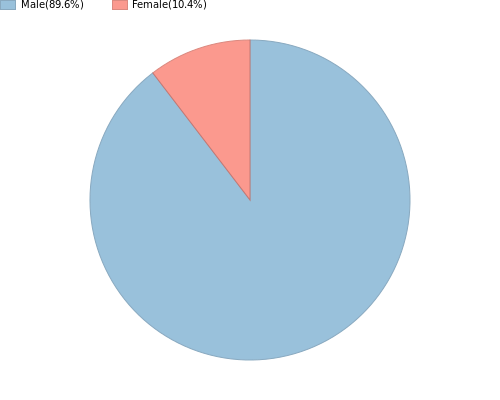
gender_it

Male and female percentages outside the IT industry
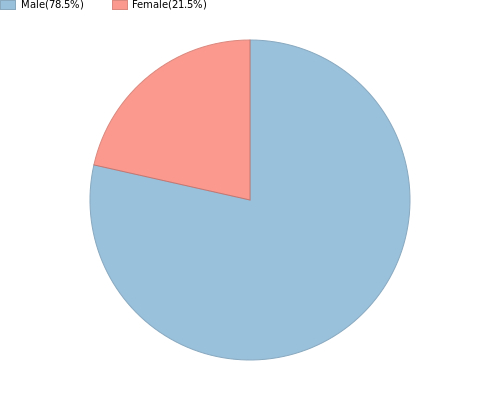
gender_nonit

Male and female percentages by language
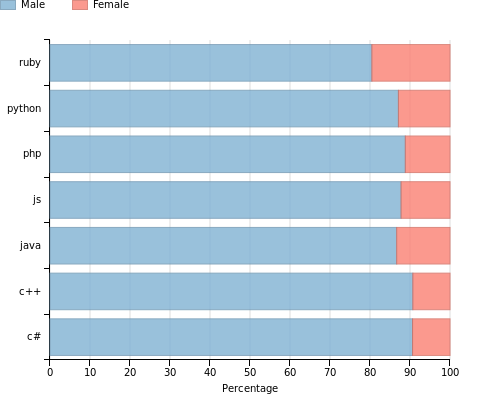
gender_language

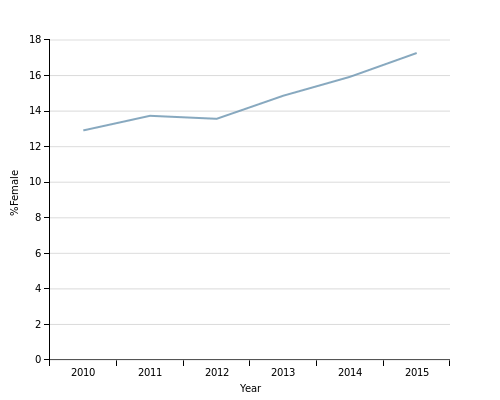
Female percentage by year

gender_time

Ruby by a large margin appears to have the highest percentage of women, and C++ the lowest.

Gender imbalance seems to be less prominent outside the IT industry, but the percentage of women across languages seems to be increasing over time.

Methodology

The source for this study was provided by our Data Services massive business profiles collection. The gender of a profile was inferred by its given name.

The programming language associated with the user was determined by inspecting the descriptions of the person’s prior experience. Two methodologies were used for this.

The first methodology, which we’ll refer to as 'Method 1', associated a user with a programming language if the language name appeared in the description.

As this can lead to a user being assigned more than one language, we also used an alternate methodology, 'Method 2', that assigned a language if that language was the only one that appeared in the description.

The results presented above were the average of these two methodologies

We considered using people's list of skills but decided against it as it would've prevented us from retrieving results by year.

We excluded languages such as BASIC due to ambiguity and analyzed jobs from 2010 to the present. We also excluded languages where there weren't enough jobs to keep our confidence interval below 1% at the 95th percentile.

If you would like additional information about our methodology or have any suggestions for a study please contact sales@zyte.com.


×

Try Zyte API

Zyte proxies and smart browser tech rolled into a single API.
Start FreeFind out more

Get the latest posts straight to your inbox

No matter what data type you're looking for, we've got you

G2.com

Capterra.com

Proxyway.com

EWDCI logoMost loved workplace certificateZyte rewardISO 27001 iconG2 rewardG2 rewardG2 reward

© Zyte Group Limited 2026