
A plethora of autonomous agents is set to claim unprecedented traffic share. In their wake, new judgements about the intent and economic merits of diverse new programmatic visitors will usher in new access regimes for different bot species.
For decades, website owners and scrapers had a simple relationship: websites published content; “good” scrapers accessed it politely, “bad” scrapers abused it. By 2026, this framing is becoming less useful.
The rise of autonomous crawlers, LLM browsing agents, shopping agents, and MCP-connected tools has created a new reality: websites can no longer afford to treat "bots" as a homogenous category - either “good” or “bad”. For website owners, different types of automated traffic generate different economic value and pose different risks.
Website operators, then, are coming to acknowledge diversity in the bot population, and are re-drawing the rules for how they welcome programmatic traffic.
Key developments
A huge share of the web will continue operating as it always has but, as AI-driven data access scales, a growing portion of the sites is nevertheless reorganizing into three new regimes:
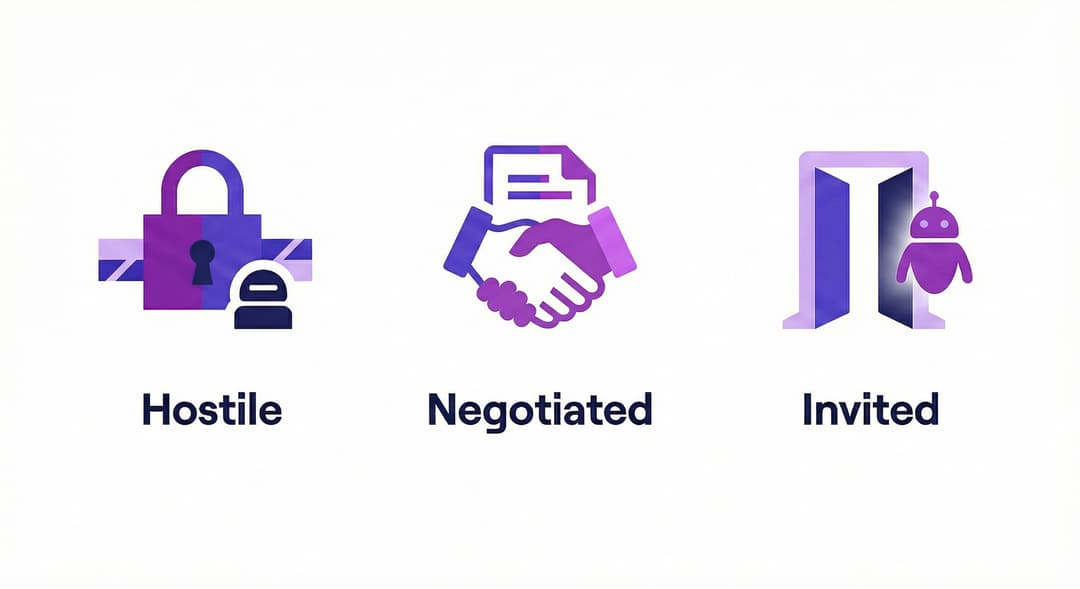
The hostile web escalates defenses against abusive automation. These sites deploy aggressive honeypot traps, AI-targeted challenge flows, and increasingly sophisticated fingerprinting. Some search services are sending clear adversarial signals toward automation – steadily redesigning their search experiences to raise the cost and friction of automated access.. Meanwhile, Cloudflare rolled out traps for AI crawlers to over 1 million websites, boasting to have blocked 416 billion AI bot requests in six months alone. The message is clear: for publishers bearish on becoming data providers, visitor friction can be enabled at the flip of a switch.
The negotiated web emerges from economic pressure. Publishers facing declining search traffic or rising costs from AI crawlers indexing their sites adopt licensing, attestation, pay-per-crawl, paywalls, and attribution mechanisms. Creative Commons recently announced tentative support for pay-to-crawl systems, and Adweek reports that 2026 will see LLM deals shift from one-time training payments to usage-based revenue shares. New standards like ai.txt, llms.txt, and Really Simple Licensing (RSL) are attempting to make permissions machine-readable, but walled-garden data ecosystems may restrict machine access except via licensing, API, or verified bot status.
The invited web turns agents into first-class distribution channels. Sites, actively inviting programmatic access to desirable actors, expose machine-first interfaces for approved actions and real-time data. E-commerce platforms are leading this shift. Shopify, Google, Visa and Stripe along with OpenAI all now either support Model Context Protocol (MCP) or have launched their own protocols for AI shopping agents - Stripe’s Agentic Commerce Protocol (ACP), Google’s Universal Commerce Protocol and Visa’s Trusted Agent Protocols. E-commerce is the first tangible sphere in which these access lanes are set to become valuable off-platform product data sources in their own right. But the same “invitation” pattern is likely to spread to other content and service categories, as websites work towards gaining more visibility in the age of AI-mediated information discovery. Going forward, expect more site owners with valuable data to make themselves available to approved agents through these kinds of structured programs.
Implications
Identity becomes a first-class citizen. New identity and attestation layers emerge. Expect standards and products for verifying bots and signing agents - initiatives like "Know Your Agent" will certainly gain traction. Verified, authenticated, or attested bots will receive preferential routing while unsigned or unverifiable bots face heightened friction. For many, machine identity will no longer be optional; it's operational.
Intention becomes a bargaining chip. Agent utility, not just legitimacy, matters. A shopping agent bringing qualified buyers is treated differently from a training crawler. Websites evaluate whether an agent's purpose aligns with their business model and data strategy. This shifts the conversation from "can you access?" to "should you access, and on what basis?"
The web becomes economically differentiated. Websites no longer operate under a single access policy. This will pave different paths for different agents. Some content remains broadly scrapeable but more guarded, other content is locked behind licensing or partnership agreements. Still other content is designed specifically for agentic interfaces. For data gatherers, this fragmentation breaks the idea of a single web access strategy.
Standards proliferate but enforcement remains uneven. ai.txt, llms.txt, RSL, MCP, and ACP all attempt to standardize machine-readable permissions. Adoption is growing but uneven; thus far, major AI providers have not universally honored these standards. However, the trajectory is clear: standardized, machine-readable access agreements will become increasingly common, particularly in commerce and publishing.
Recommendations
Map your data sources against the three new access regimes. For each data source in your pipeline, determine whether it now belongs in the “hostile”, “negotiated”, or “invited” web buckets - or in none at all. Evaluate the long-term path based on technical difficulty, breakage risk, maintenance burden, and legal friction. The cost of acquiring web data must be compared against licensing costs, API fees, and partnership opportunities.
Build organizational capabilities. Organizations must build capabilities across all three regimes. This means maintaining robust scraping infrastructure for hostile-web targets, developing identity and attestation capabilities for negotiated-web access, and integrating with agentic commerce protocols where applicable. The single-strategy approach no longer works.
Resolve the discoverability paradox for your own web assets. Decide which automated systems you welcome and which you block. Design your interfaces, metadata, and feeds accordingly. If you want to be accessed, make it frictionless. If you want to negotiate, expose licensing endpoints. If you want agentic integration, implement the relevant protocols such as MCP and ACP.
Monitor standards evolution closely. ai.txt, llms.txt, RSL, and emerging licensing frameworks will shape the negotiated web. Early adoption of supported standards positions you for better access terms and lower friction as these standards mature.