
The past three weeks have been unusually busy in AI, even by 2026 standards.
Anthropic shipped Claude Sonnet 5 on June 30 and restored access to Claude Fable 5 on July 1, and, on July 9, OpenAI made the GPT-5.6 family (Sol, Terra, and Luna) generally available.
So Zyte's R&D team did what it always does when the frontier moves: we ran them all through our benchmark for AI-generated scraping code, alongside the previous generation of models.
The verdict
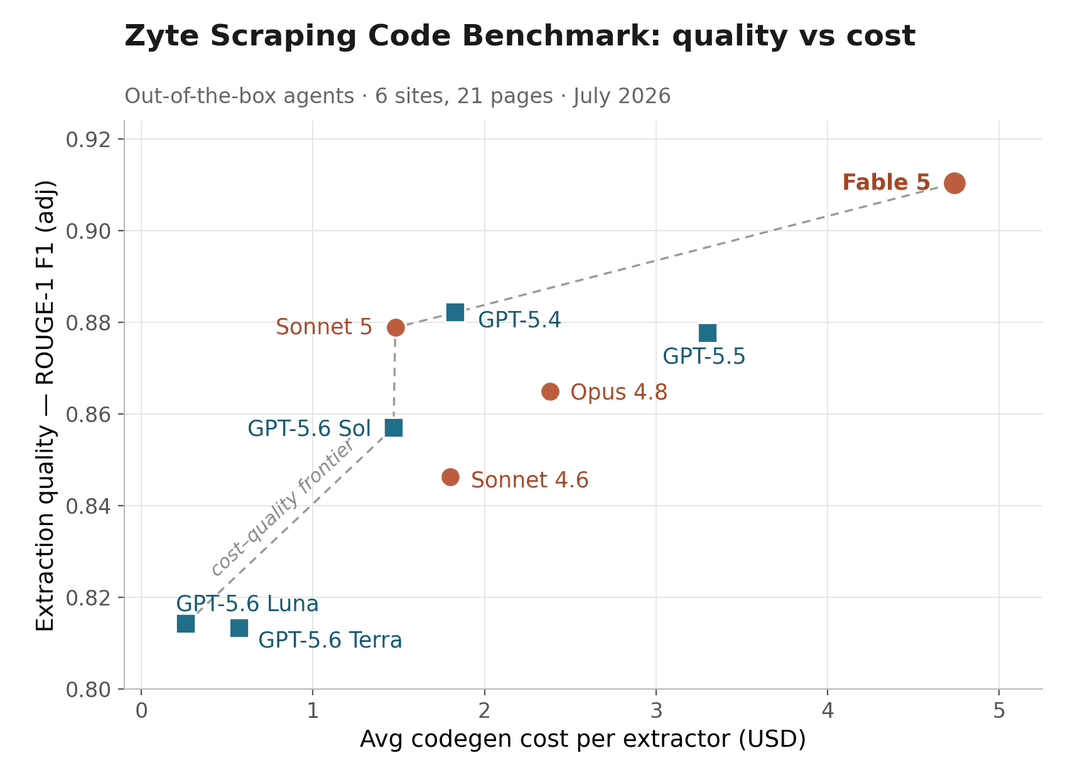
The result is unambiguous. Extraction code written using Claude Fable 5 produces the best-quality data output of any model we have tested, with a ROUGE-1 F1 (adj) score of 0.910 - that’s about 0.03 ahead of the next group. Given how tightly the rest of the field is packed, that is a clear lead.
| Model | Agent | ROUGE-1 F1 (adj) | Avg $/run | Avg SLOC | Avg run time |
|---|---|---|---|---|---|
| Claude Fable 5 | Claude Code | 0.910 | $4.74 | 239 | 9m 48s |
| Codex GPT-5.4 | Codex | 0.882 | $1.83 | 300 | 5m 16s |
| Claude Sonnet 5 | Claude Code | 0.879 | $1.48† | 202 | 9m 05s |
| Codex GPT-5.5 | Codex | 0.878 | $3.30 | 298 | 7m 02s |
| Claude Opus 4.8 | Claude Code | 0.865 | $2.38 | 212 | 8m 58s |
| GPT-5.6 Sol | Codex | 0.857 | $1.47 | 192 | 6m 38s |
| Claude Sonnet 4.6 | Claude Code | 0.846 | $1.80 | 195 | 10m 49s |
| GPT-5.6 Luna | Codex | 0.814 | $0.26 | 152 | 3m 54s |
| GPT-5.6 Terra | Codex | 0.813 | $0.57 | 122 | 3m 45s |
Zyte Scraping Code Benchmark, July 2026. 6 sites, 21 test pages. ROUGE-1 F1 (adj) measures extracted values against annotated ground truth, normalized per site; higher is better. † Introductory pricing; see footnotes on cost and run time below.
Behind Fable 5, three models are effectively tied: Codex GPT-5.4 (0.882), Claude Sonnet 5 (0.879), and Codex GPT-5.5 (0.878). With one run per model, differences of about 0.01 are within noise, so we read this as one cluster rather than a ranking.
Surprise 1: GPT-5.6 doesn't move the frontier for scraping code
The headline of the week is GPT-5.6 - but, on this task, the new family does not move the needle for data quality.
Sol in predecessor’s shade
- GPT-5.6 Sol, the flagship, scored 0.857 - that’s below OpenAI's earlier GPT-5.4 and GPT-5.5 models.
- Per-site results were mixed (Sol won two sites outright).
- But, in aggregate, the older Codex models still write better extraction code.
Sol a good, balanced pick
What Sol does deliver is cost: at $1.47 per extractor, it is less than half the price of GPT-5.5 ($3.30), for quality that is only slightly lower. If you were running GPT-5.5 for scraping code generation, Sol is a straightforward cost win.
Luna wins the budget end
Terra and Luna, the budget tiers, are a different product entirely.
- They wrote roughly half as much code, finished in under four minutes, and cost $0.26 to $0.57 per extractor.
- But their extracted data quality landed at ~0.81, clearly below everything else.
- Those quality losses come more from value precision than from missing fields. On the simplest site in the set, Luna scored 0.774 for extraction quality where GPT-5.5, Sol, and Terra all scored ~0.881 on the same fields.
The two budget tiers land in the same place on quality; Luna gets there at half of Terra's cost.
Surprise #2: Sonnet 5 is the value pick
The cost column has a story of its own. Claude Sonnet 5 delivered cluster-level quality (0.879) at $1.48 per extractor - the cheapest run of any model above the budget tiers, and essentially the same price as GPT-5.6 Sol ($1.47), for clearly better output.
- Part of the reason is Anthropic's introductory pricing ($2/$10 per million tokens through August 31). At standard rates, the same run would cost about $2.22 - still the cheapest in its quality cluster.
- For extraction quality, Sonnet 5 is also a big step over its predecessor: 0.879 vs Sonnet 4.6's 0.846 in the identical setup. That is the same kind of generation-over-generation jump we saw when Sonnet 4.6 topped this benchmark in February.
Top quality has a price. Fable 5 cost $4.74 per extractor, roughly 3x Sonnet 5, for its +0.03 quality lead.
Fable 5 is still more token-efficient than its price sheet suggests:
- Its list price is 3.3x Sonnet 5's standard rate. But its runs cost only about 2.1x as much, meaning it used roughly a third fewer price-weighted tokens for the same task.
- And $4.74 for a working, tested extractor remains far below the cost of the engineering time it replaces.
What we measured, and what changed
The Zyte Scraping Code Benchmark gives a coding agent saved HTML pages from a real website, plus a target schema, and asks it to write code that extracts the schema's fields from each page.
We score the extracted values against carefully annotated ground truth. Our current test data set covers six sites and 21 pages, including:
- E-commerce product and product listing pages, including categories and next-page URLs.
- Several languages.
- Schemas up to ~25 fields.
- Pages up to multiple megabytes of HTML.
It is a representative subset of the larger dataset behind our previous benchmarks, with small ground-truth fixes - so scores here are not directly comparable to previously published numbers.
This time, we tested the models as coding agents out of the box:
- Each in its native harness (Claude models in Claude Code, OpenAI models in Codex CLI).
- Reasoning effort set to high, with an identical, separate evaluation pass scoring every model.
Which model should you pick?
- Best quality: Claude Fable 5 is the clear winner - at $4.74 per extractor, it is the most expensive run in the table, but the premium is trivial next to the engineering time it saves.
- Balanced: GPT-5.4, Sonnet 5, and GPT-5.5 are interchangeable on quality. Sonnet 5 was the cheapest of the three ($1.48 at introductory pricing, ~$2.22 at standard). GPT-5.6 Sol matches that price at somewhat lower quality - the better pick mainly if you're committed to the OpenAI stack.
- Budget: GPT-5.6 Luna at $0.26 per extractor, if you accept ~0.10 lower quality and check the output more carefully.
One more pattern worth noting for maintainers is code complexity:
- Claude models consistently write less code than the older Codex models for the same task - roughly 200–240 source lines of code (SLOC) vs ~300.
- The GPT-5.6 family reverses Codex's verbosity - Terra wrote the least code of any model, at a quality cost.
What the agents still can't do
Every model in this table was handed the gift of clean, saved HTML from which to extract.
But getting that HTML from real websites at scale - past bans and bot detection - and running, scheduling, and monitoring the resulting spiders in production is exactly what none of these agents solve on their own.
That is where our stack sits:
- Zyte API for access, with automatic ban handling driven by a library of 320,000 strategies, browser rendering, sessions, and data extraction.
- Scrapy Cloud for operations, with cloud hosting, monitoring, logging and quality assurance for spiders at scale.
- Agentic Web Data with agent skills that wire your coding agent or development environment into both.
The agents can help write great code, but they still need a great environment in which to run it; they still need the infrastructure and access tooling to get pages to the point of extraction in the first place.
Footnotes
- Cost: per-extractor cost of the code-generation phase, as reported by each agent's CLI at standard API rates. Sonnet 5 is shown at its introductory pricing ($2/$10 per million tokens through August 31, 2026); at standard $3/$15 pricing its cost would be about $2.22 per extractor.
- Run time: wall-clock per extractor, including identical infrastructure overhead (container start, repo clone/push) for every model.
- Noise: one run per model per extractor. Differences of ~0.01 ROUGE are within noise; Fable 5's +0.03 lead is comfortably above it.