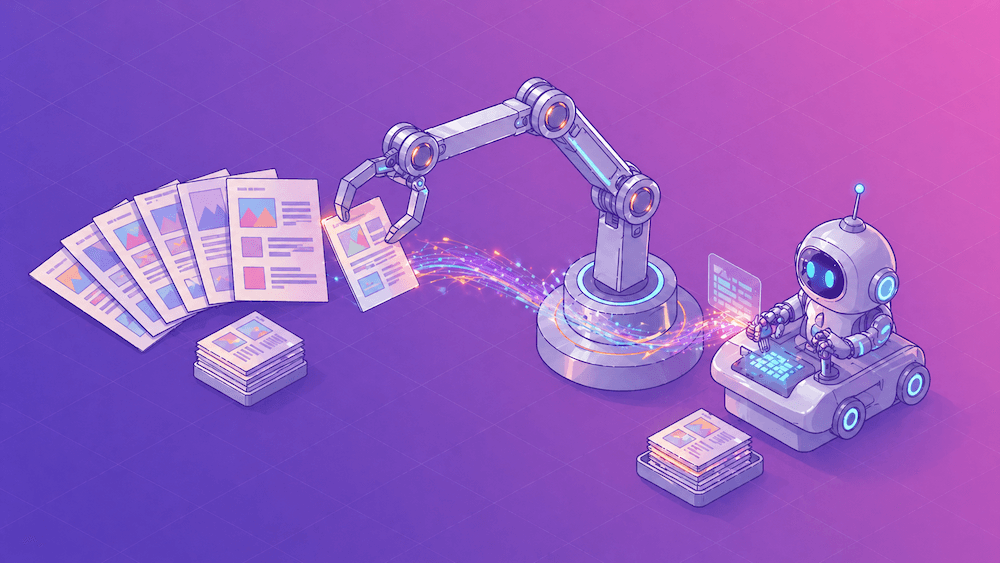
Agentic AI is moving rapidly from research to production. Gartner predicts that 40% of enterprise apps will feature task-specific AI agents by 2026, up from less than 5% in 2025.
Yet agent failures are common. Hallucinations, outdated reasoning, and inability to access current information lead to poor decisions that damage user trust.
Agentic AI promises autonomous reasoning and decision-making - but only if agents have access to grounded, current, and accurate data.
Why agents need access to real-time web data
Intuitively, AI agents make better decisions when they have access to current, relevant information. Agents without access to current information also can't adapt to real-world changes like market conditions, regulatory requirements, or user preferences shifting.
Web data is one of the sources that AI agents now rely on for grounding with the real world. Agentic services integrate web data retrieval into their workflow, enabling deep research, recommendation, and enrichment.
Organizations that solve these challenges systematically will build agents that users can trust to make reliable decisions.
How leading organizations build reliable agentic AI systems with web data
Building that trust requires three foundational capabilities.
1. Low-latency extraction: Empowering agents with on-demand web data retrieval
Some information is too fast-moving to pre-load - stock prices, current news, market data. Agents need the ability to call their own “tools” (invoking external services to perform specific tasks that extend agents’ capabilities) to retrieve current information when needed for decision-making.
Fortunately, web scraping has now become a tool that agents can call on-demand.
Take the case of one data enrichment platform built a suite of AI agent-callable APIs that other companies' agents can invoke on-demand to access current web data. Rather than building its own scraping infrastructure to help those agents access the web, it relies on Zyte’s enterprise-grade infrastructure to ensure its agent tools never fail when called.
By adding Zyte API into a list of tools that the agents can call,, the company’s agents can search the web, extract content from pages, enrich database records, and monitor for changes - all with sub-second latency and guaranteed uptime.
This tool is a function that wraps a call to Zyte API:
1def zyte_extract(
2    url: str,
3    extraction_type: str = "product",
4    extract_from: Optional[str] = None
5) -> Dict[str, Any]:
6    """
7    Extract structured data from a web page using Zyte API.
8
9    Args:
10        url: The webpage URL to extract from
11        extraction_type: Type of data to extract
12            - "product"/"productList"
13            - "article"/"articleList”
14            - "serp": Search engine results page
15            - "pageContent": Clean page content
16        extract_from: Extraction source (optional)
17            - "httpResponseBody": Faster (default for most)
18            - "browserHtml": Better for JavaScript-heavy sites
19            - "browserHtmlOnly": Rendered HTML only
20    """
21    ... (redacted for brevity)
22    # Call Zyte API
23    response = requests.post(
24        "https://api.zyte.com/v1/extract",
25        auth=("YOUR_ZYTE_API_KEY", "" ),  # API key as username
26        json=payload
27    )
28    ... (redacted for brevity)
29    # Return structured result
30    return {
31        "status": "success",
32        "url": result.get("url"),
33        "latency_ms": response.elapsed.total_seconds() * 1000,
34        "data": result.get(extraction_type),
35        "raw_response": result
36    }
37That tool can now be included in the agent’s list of available tools:
1tools = [
2    {
3        "type": "function",
4        "function": {
5            "name": "zyte_extract",
6            "description": "Extract structured data from web pages",
7            "parameters": {
8                "type": "object",
9                "properties": {
10                    "url": {"type": "string", "description": "The URL"},
11                    "extraction_type": {"type": "string", "enum": ["product", "article"]}
12                },
13                "required": ["url", "extraction_type"]
14            }
15        }
16    }
17]
18Zyte API's enterprise-grade infrastructure with SLA guarantees ensures agents can reliably call web scraping tools when needed, eliminating failures that would undermine agent confidence. The infrastructure is optimized for fast retrieval, ensuring agents access current information in structured format, enabling time-sensitive decisions within seconds rather than minutes.
Example: Speed through reliable access
Zyte API's reliable access management also enables agents to call web scraping tools without worrying about bans or rate limiting. Transparent pricing and usage tracking enable teams to estimate and optimize costs per agent tool call, making agentic AI economics viable at scale.
With structured data that agents can process immediately, AI agents can access current information on-demand.
Here is how a tool can wrap a rapid-fire call to Zyte API:
1{
2  "type": "function_call",
3  "name": "zyte_extract",
4  "arguments": {
5    "urls": [
6        "https://supplier.com/semiconductors”,
7        "https://vendor.com/listall”
8    ],
9    "extraction_type": "product"
10  },
11  "call_id": "call_zyte_001"
12}
13And here is what comes back:
1{
2  "tool_call_output": {
3    "type": "search_and_extract",
4    "search_query": "current market price for semiconductor chips",
5    "timestamp": "2026-04-27T14:32:15Z",
6    "results": {
7      "status": "success",
8      "runtime_ms": 342,
9      "data": {
10        "prices": [
11          {"chip": "A100", "price": "$12,500", "source": "supplier.com"},
12          {"chip": "H100", "price": "$15,000", "source": "vendor.com"}
13        ]
14      }
15    }
16  }
17}
18Tool reliability increases confidence in the agentic system. Reliable web scraping infrastructure becomes the foundation for scalable agent tool ecosystems, enabling thousands of agents across different organizations to access current information on-demand without worrying about infrastructure failures or rate limiting.
2. Knowledge graph construction: Building relationship data for agent reasoning
The idea behind knowledge graphs has been brewing since the 1950s. But adoption took off in the web age, with the rise of graph databases in mainstream applications.
Unlike relational databases where information is captured in rows and columns, knowledge graphs organize data as an interconnected network where meaning is explicitly encoded in relationships.
These days, knowledge graphs enable AI agents to understand relationships between entities (say, companies, people, or products) and use that context for sophisticated reasoning.
Agents reasoning over knowledge graphs make decisions that are 30% to 40% more accurate than agents reasoning over less accurate graphs. Knowledge graph-based retrieval also improves accuracy and reduces hallucination rates by 40%.
But building and maintaining knowledge graphs at scale requires continuous updates from multiple sources. It requires structured data about entities, relationships, and temporal context. Detecting new facts, relationships, and changes in real-time is a complex data engineering problem.
Example: Agents understand dynamic CRM updates
One startup came to Zyte to build a data pipeline to enrich its database of companies and funding sources tobuild a map of relationships between them.
Zyte API's customAttributes feature, which allows teams to use natural language to describe what to extract from unstructured on-page data, enables extraction and structuring of relationship data that flows directly into knowledge graph ingestion pipelines. This allows an ingestion of feeds that capture company information, relationships, and executive changes as they emerge, ensuring knowledge graphs stay current with real-world changes.
1{
2  "entities": [
3    {
4      "id": "company_12345",
5      "type": "Company",
6      "properties": {
7        "name": "TechCorp Inc",
8        "founded": "2015",
9        "industry": "Software"
10      }
11    },
12    {
13      "id": "funding_67890",
14      "type": "Funding",
15      "properties": {
16        "name": "Funding Source 1"
17      }
18    }
19  ],
20  "relationships": [
21    {
22      "source": "funding_67890",
23      "target": "company_12345",
24      "type": "LEADS",
25      "properties": {
26        "startDate": "2024-06-15",
27        "endDate": null
28      }
29    }
30  ]
31}
32
33Structured in a custom format like this using customAttributes, extracted web data can be ingested directly into leading knowledge graph solutions like Neo4j using Cypher queries.
Agents reasoning over high-accuracy knowledge graphs with fresh web data make better decisions that translate to better business outcomes. Lead scoring improves, relationship mapping becomes more comprehensive, and agents can reason about complex multi-step business scenarios with confidence.
3. Knowledge base maintenance: Keeping agent knowledge current
While knowledge graphs focus on relationships between entities, knowledge bases focus on documents and information retrieval. According to research from Indium Tech, retrieval augmented generation (RAG) systems still hallucinate in 10% to 15% of cases, especially when documents are ambiguous or when users ask multi-step reasoning questions.
Real-time knowledge base updates reduce hallucination rates to less than 1%, compared to 15% to 20% for knowledge bases that are updated infrequently.
But building a robust knowledge retrieval system requires continuous feeds of structured, current information that enables agents to retrieve relevant knowledge at different decision points.
Example: Accuracy through current knowledge
Imagine a financial services platform building an AI agent to help customers understand market trends and investment opportunities. Aside from tapping into proprietary knowledge bases, the agent needs access to real-time financial news, analyst reports, and market data from public web sources. To stay current, such a platform would need to continuously monitor and extract structured information from all these data sources multiple times daily.
Extracting the right information from diverse sources in a consistent, structured format is what Zyte API's article extraction can help solve. It reliably extracts structured content from any website, seamlessly handling a variety of layouts.
But structured content isn't enough for production agents. Agents benefit from domain-specific information. That's where customAttributes comes in. By defining a schema of domain-specific fields such as market impact, affected sectors, and indicative risk level, Zyte API will extract these fields in one swoop, alongside the article metadata. The result is rich, queryable knowledge base entries that agents can immediately filter, rank, and reason over.
By sending extraction request such as:
1{
2  "url": "https://example.com/market-analysis/fed-rate-decision",
3  "article": true,
4  "customAttributes": {
5    "marketImpact": {
6      "type": "string",
7      "description": "How this news affects financial markets (stocks, bonds, forex, commodities )"
8    },
9    "affectedSectors": {
10      "type": "array",
11      "description": "Which economic sectors are most affected (tech, finance, energy, healthcare, etc.)",
12      "items": {
13        "type": "string"
14      }
15    },
16    "riskLevel": {
17      "type": "string",
18      "description": "Risk assessment for investors",
19      "enum": ["low", "medium", "high", "critical"]
20    },
21    "relatedPolicies": {
22      "type": "array",
23      "description": "Any regulatory policies or central bank decisions mentioned",
24      "items": {
25        "type": "string"
26      }
27    }
28  }
29}
30
31Zyte API returns the following structured response:
1{
2  "url": "https://example.com/market-analysis/fed-rate-decision",
3  "statusCode": 200,
4  "article": {
5    "title": "Federal Reserve Maintains Interest Rates at 5.25-5.50%",
6    "author": "Jane Smith, Chief Economist",
7    "publishedDate": "2026-04-27T14:30:00Z",
8    "body": "The Federal Reserve's policy committee voted unanimously to maintain the federal funds rate at 5.25-5.50%, marking the fifth consecutive meeting without a change. Chair Powell emphasized the need for continued vigilance on inflation, noting that recent economic data shows mixed signals.",
9    "images": [
10      {
11        "url": "https://example.com/images/fed-chair.jpg",
12        "alt": "Federal Reserve Chair Powell"
13      }
14    ],
15    "links": [
16      {
17        "url": "https://federalreserve.gov/newsevents/pressreleases/monetary20260427a.htm",
18        "text": "Official Fed Statement"
19      }
20    ]
21  },
22  "customAttributes": {
23    "values": {
24      "marketImpact": "Rate hold with hawkish guidance supports bond yields and strengthens the dollar. Equity markets likely to see volatility as investors reassess growth expectations.",
25      "affectedSectors": [
26        "Financial Services",
27        "Technology",
28        "Consumer Discretionary",
29        "Real Estate"
30      ],
31      "riskLevel": "high",
32      "relatedPolicies": [
33        "Federal Funds Rate Target",
34        "Quantitative Tightening",
35        "Inflation Targeting"
36      ]
37    }
38  }
39}
40
41The publication date extracted by Zyte API also allows your system to determine when articles in the knowledge base exceed a staleness threshold and trigger refreshes accordingly. This transforms the AI agent’s knowledge base maintenance from a manual, reactive process into an automated, proactive one.
When agents can reason with current information, investment decisions improve, market insights become more timely, and agents can advise on complex multi-step scenarios with confidence.
Laying the foundations for an autonomous future
Agentic AI will become the dominant paradigm for autonomous systems - but only for organizations that can provide agents with reliable, current data. As agents enable more autonomous workflows, the importance of data infrastructure increases.
Whether it's maintaining fresh knowledge bases, building accurate knowledge graphs, or enabling on-demand tool access, reliable web data extraction is the foundation of trustworthy agentic AI systems.


.png&w=3840&q=75)