The name implies gradualism. A rate limit sounds like a speed restriction - slow down and you'll be fine, send fewer requests per minute and the road opens up.
The data from State of Web Access 2026 tells a different story entirely.
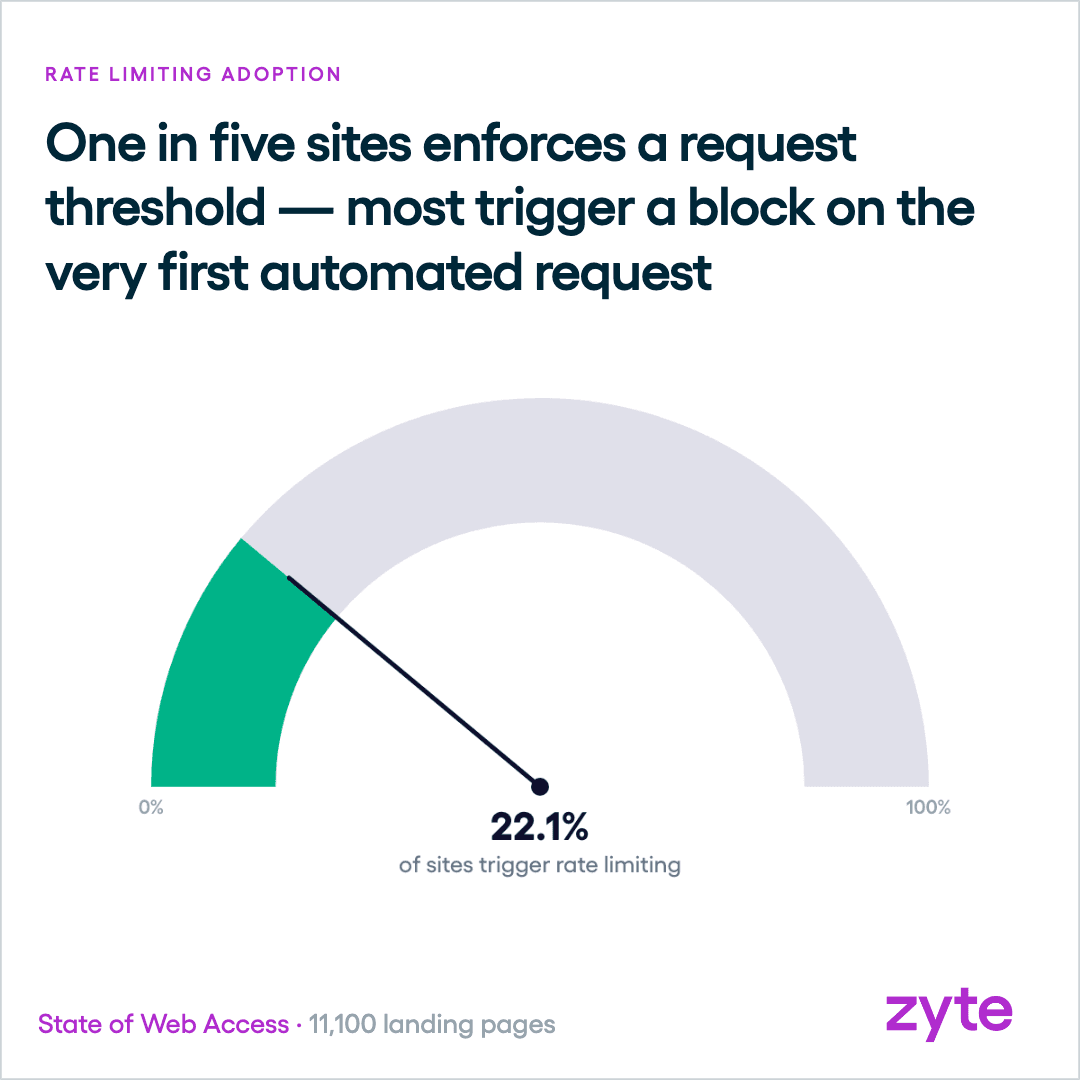
Rate limiting is employed by on 22.1% of the world's most popular 11,000 websites' landing pages.
But, of those sites, 93.7% block on the very first automated request - at a one-second interval, with no prior activity.
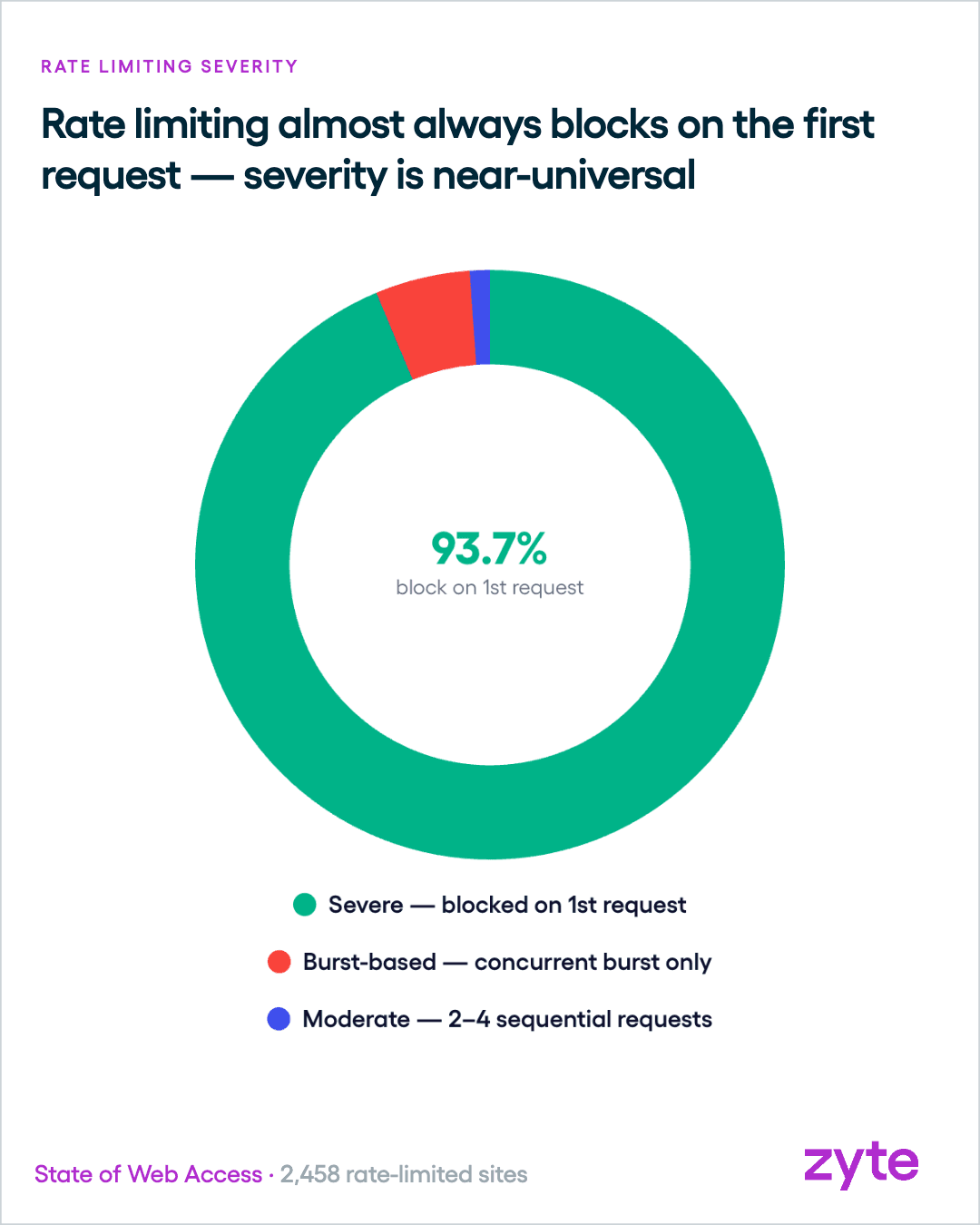
They are not measuring how fast you're going, they have already decided who you are.
Rate limiting - as actually deployed across the web, then - is less a throttle, more a binary identity check.
Rate limiting blocks on the very first request
To understand why this matters, it helps to understand what rate limiting is supposed to do.
The canonical implementation caps request frequency - a server allows N requests per time window from a given source, and rejects requests beyond that threshold.
The HTTP specification even has a purpose-built response code for this scenario: 429 Too Many Requests, introduced in RFC 6585 in 2012, with an optional Retry-After header that tells the client when the quota window resets and requests can resume.
This is how APIs almost universally implement rate limiting. It's polite, machine-readable, and allows legitimate clients to back off and retry without manual intervention.
Web-facing rate limiting looks almost nothing like this.
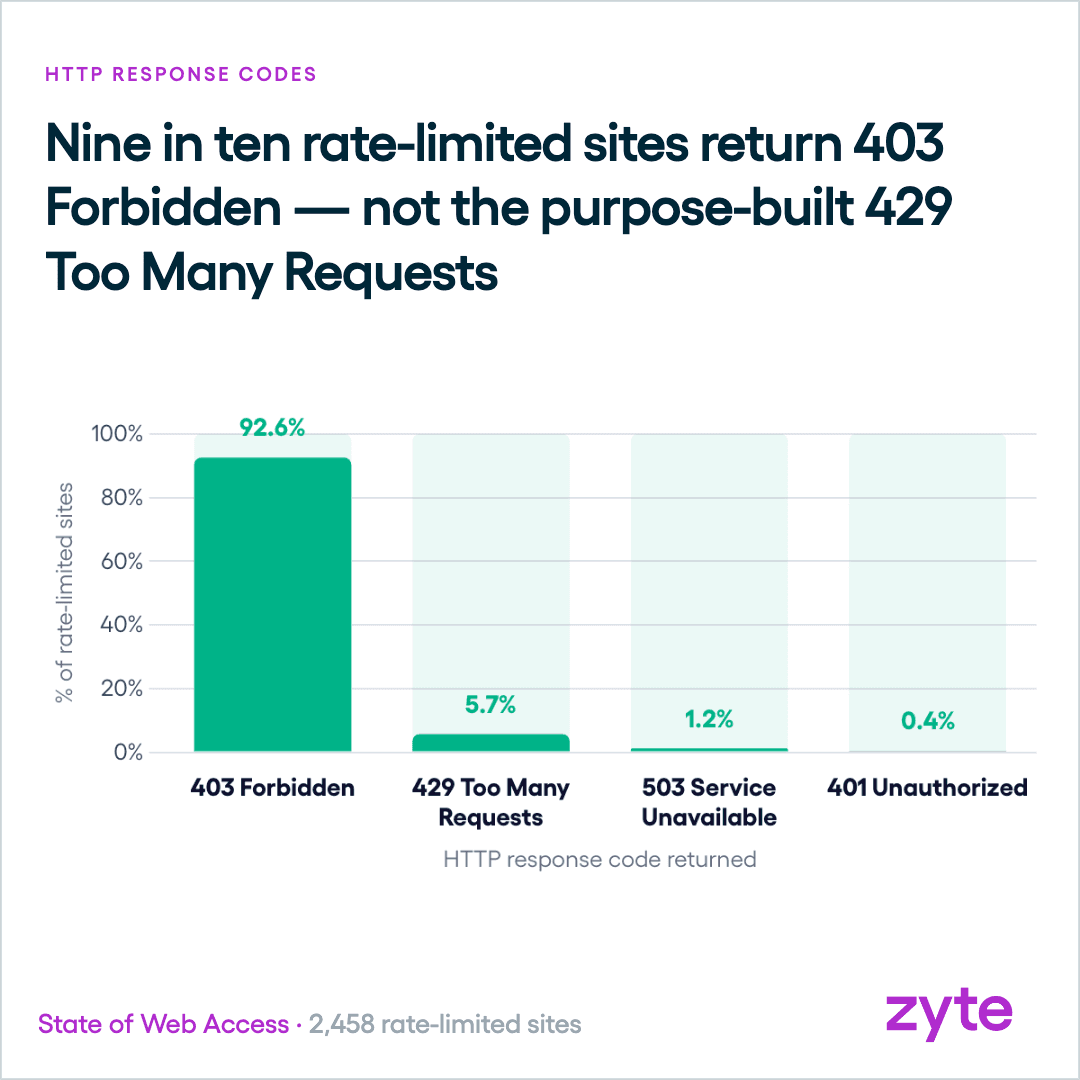
In our dataset, 92.6% of rate-limited sites return 403 Forbidden when they block - a generic access-denied code that reveals nothing about a quota, a window, or a threshold.
Only 5.7% use 429. Without a 429, there is no Retry-After header. A blocked client receives no signal about whether slowing down would help, or when it might try again.** The 403 says: "You are not allowed here". It does not say: "Come back in 60 seconds."**
The response code is a design choice. Sites returning 403 have made a decision - consciously or by default - not to invite crawlers to retry. They are not so much managing traffic as refusing it.
Rate limiting keys on client identity
If a site blocks your first request at a one-second interval, it has not observed your request frequency. It cannot possible have - you've made just one request.
What it has observed is something else: the characteristics of your request that identify it as automated:
- The TLS fingerprint.
- The absence of certain browser headers.
- The User-Agent.
- The IP range.
The "rate" that's being limited, in the overwhelming majority of deployments, is the rate at which a particular class of client is permitted to access the site at all - zero requests per minute, effective immediately. The trigger is identity, not velocity. These days, the name "rate limit" is almost a misnomer.
This has practical implications for anyone trying to understand what they're dealing with. A site returning 403 on your first request has nothing to do with your speed; it is telling you that your client profile triggered a block rule.
Slowing down will not help. Changing the profile - the fingerprint, the request headers, the IP origin - is what the situation calls for.
Fashion leads at 54%, guarding its pricing
The industry distribution for rate limiting is dominated by consumer-facing commerce with volatile pricing data.
Apparel and fashion leads at 54% - more than twice the global average. Sporting goods follows at 49%. Jewelry and luxury products at 42%. Restaurants at 41%. Furniture at 40%.
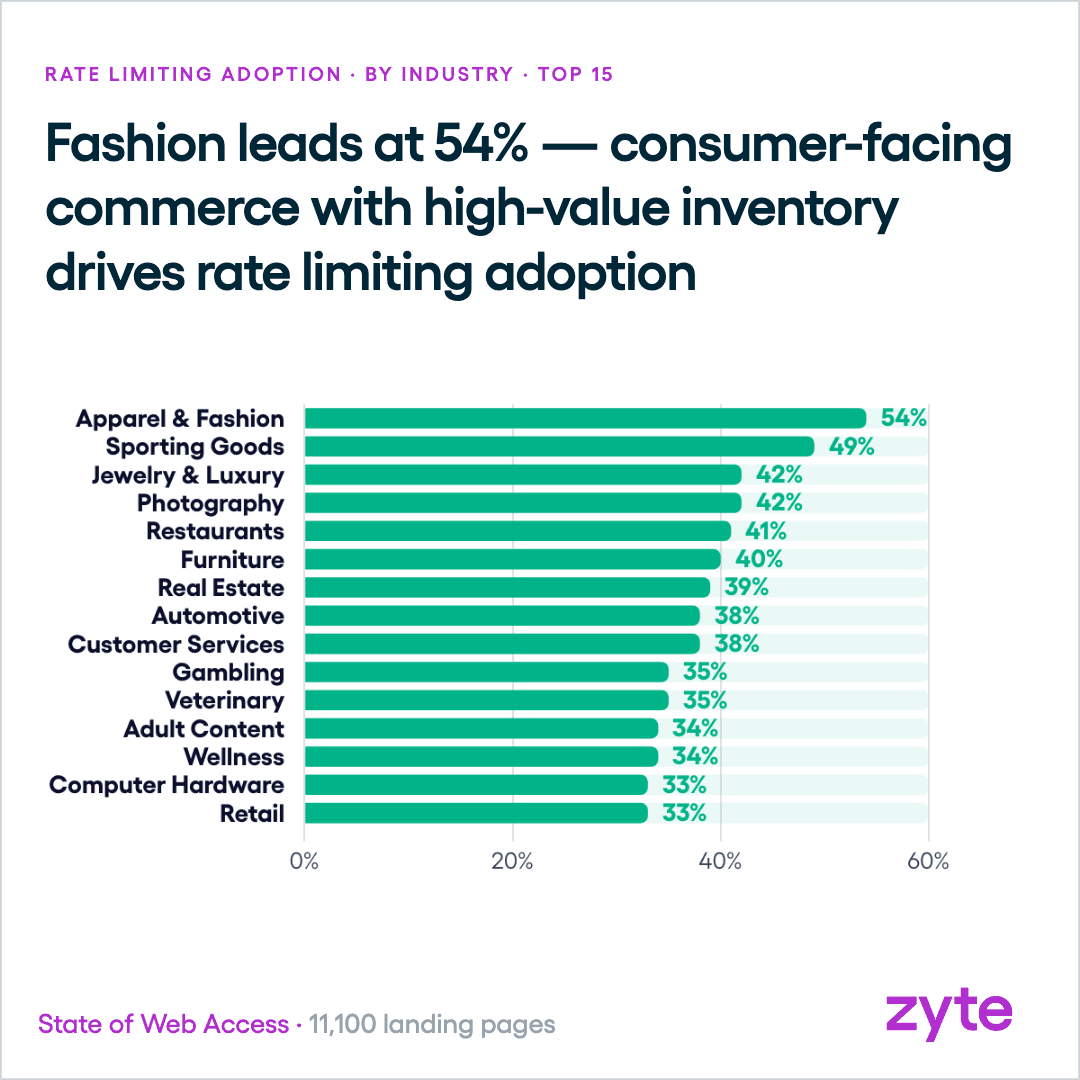
The common thread is competitive intelligence, not fraud or a security threat in any conventional sense.
Fashion brands and multi-brand retailers operate in an environment where competitor pricing visibility may be commercially damaging. If a competitor can programmatically monitor your pricing strategy in real time - watching how you respond to their promotions, when you discount, what margin structures you run by product category - it undermines pricing power directly.
Rate limiting in fashion is defending proprietary commercial data from a legitimate business challenge: systematic competitive intelligence gathering. The "security" product is doing competitive strategy work.
Opposite of CAPTCHA: adoption scales with size
One of the more revealing contrasts in State of Web Access 2026 is what rate limiting and CAPTCHA do at different traffic scales - because they do opposite things.
CAPTCHA adoption declines as site traffic grows: small sites use it most, large sites least. The logic is cost of friction: at scale, visible verification challenges measurably reduce conversion, and large sites have the budget for invisible alternatives.
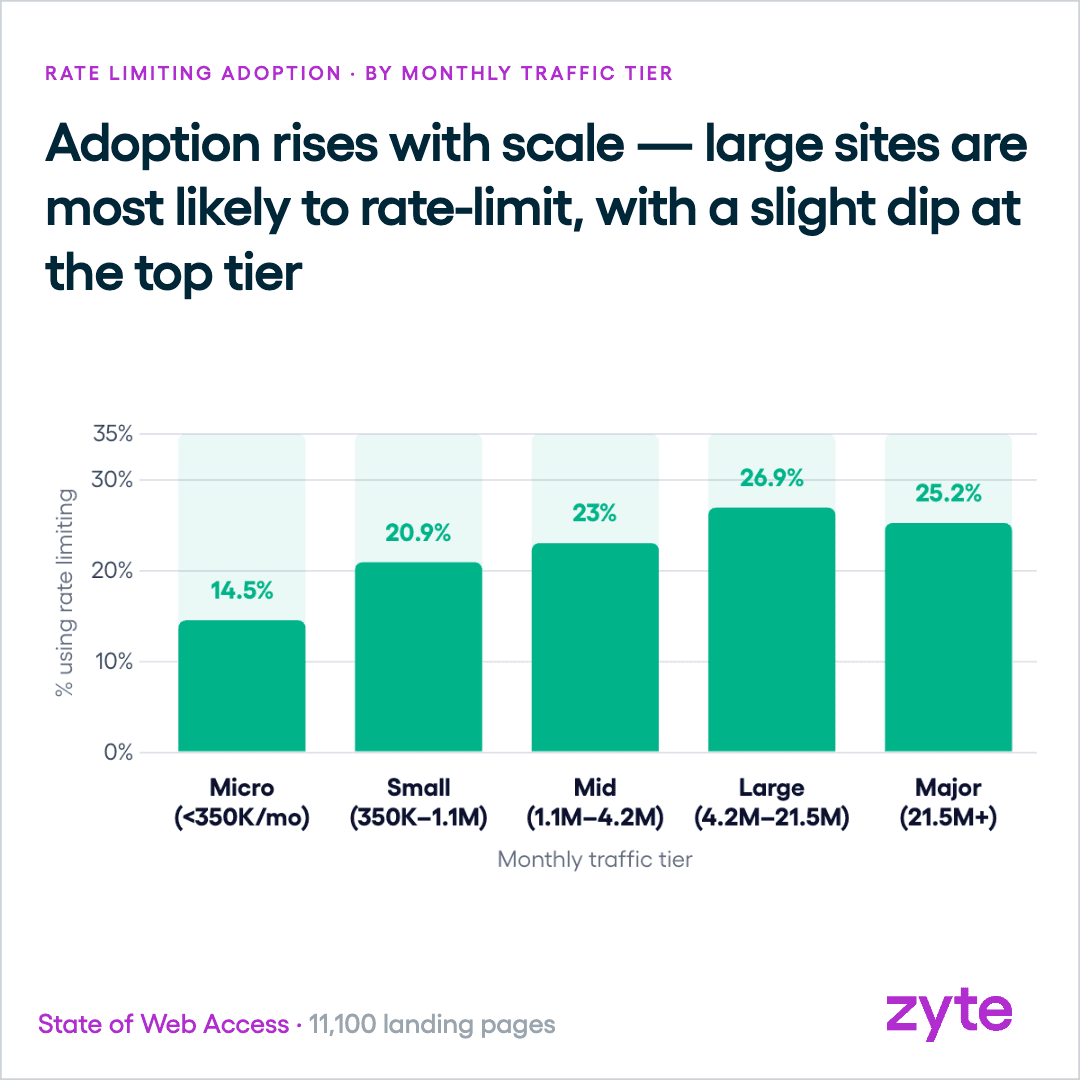
Rate limiting does the reverse. Adoption is lowest for micro sites (14.5% for sites under 350,000 monthly visits) and rises steadily through the traffic bands, peaking at 26.9% for large sites (4.2–21.5 million monthly visits) before a modest dip at the very top tier.
The logic here is also cost - but the cost being measured is the cost of uncontrolled scraping, not the cost of friction. A small site with modest traffic and limited data value rarely faces systematic scraping pressure severe enough to justify deploying and tuning rate limiting.
A large e-commerce platform or real estate portal with millions of monthly visits has priced-to-the-minute inventory data that attracts systematic extraction and has the technical resources to defend it.
The slight dip at the very largest sites (21.5M+ visits, 25.2%) is consistent with the co-occurrence picture: at that scale, antibot and TLS fingerprinting have likely taken over the heavy lifting.
Rate limiting almost never travels alone
Rate-limited sites exhibit amongst the most extreme co-occurrence pattern of any access control category in our research.
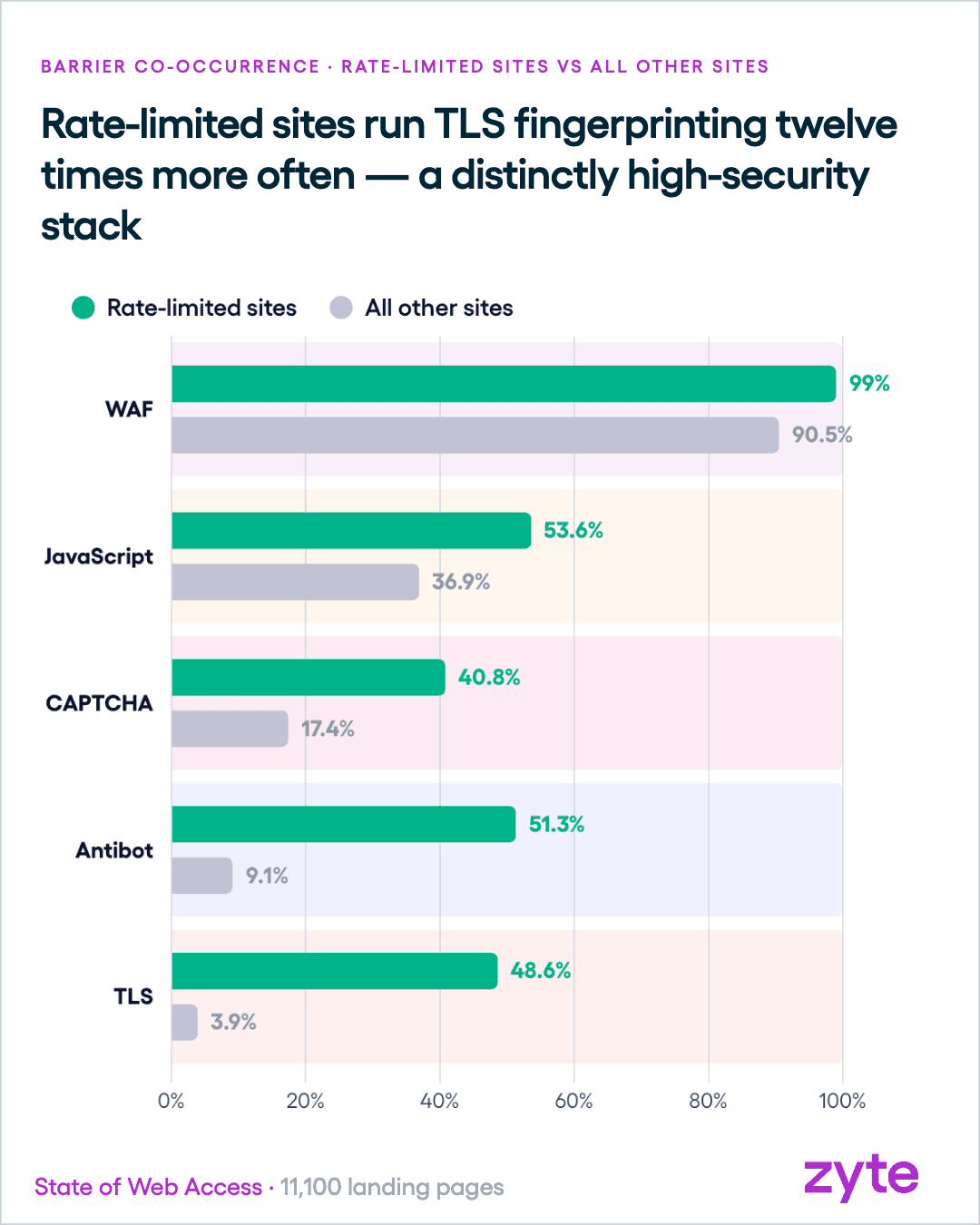
TLS fingerprinting - present on just 3.9% of non-rate-limited sites - appears on 49% of rate-limited sites: a 12x difference. Antibot is present on 51% of rate-limited sites versus 9% of others. CAPTCHA runs at 40.8% versus 17.4%.
These are not one-and-done deployments; each runs a comprehensive, deliberately layered access control stack, with rate limiting as one component among several.
Finding rate limiting on a site is probably the strongest single signal in the dataset that you're dealing with an adversarially-configured environment - more so than CAPTCHA, more so than antibot alone. It flags a site that has thought systematically about access control at every layer.
What the 403 means in practice
For a data gatherer, the practical read of rate limiting as deployed across the web is this: a 403 on a first or early request is rarely about request frequency at all; it is a block triggered by client identity - something about the request profile that a WAF or rate-limiting rule has matched to an automated pattern.
Unlike API calling, in which a developer may engineer a sequential back-off, slowing down achieves nothing here. The fix is to work out which aspect of the fingerprint triggered the block - IP reputation, TLS characteristics, request headers, behavioral signals - and address that specifically.
That mismatch between the product's name and its actual behavior is perhaps the clearest example among the six barriers of how the tools the web uses to defend itself have evolved well beyond their original descriptions.