The first days of September 2026 gave us two model launches that, read together, tell a more interesting story than either does alone. Anthropic shipped Claude Fable 5.1 on September 1, and Zhipu's GLM-5.3-Flash, which launched August 26, turned out to be the anonymous "Ox Alpha" model that had been running free on OpenRouter since August 20.
I had a hand in that second story, which I'll get to. The real headline isn't which model wins a leaderboard. It's that the frontier moved at both ends of the price range within days of each other, and if you're running scraping or extraction agents, that's the part to pay attention to.
Fable 5.1's numbers, and where they narrow
Anthropic's comparison table has Fable 5.1 leading every row against Fable 5, Claude Opus 5, and GPT-5.6 Sol: 52.6% on Terminal-Bench-Science 0.1 against 24.7% for Fable 5 and 29.0% for Opus 5, 55.8% on Terminal-Bench 4.0 against 42.0% for Fable 5, and a jump on OSWorld 2.0 from 72.9% to 77.9% on the partial-credit scoring.
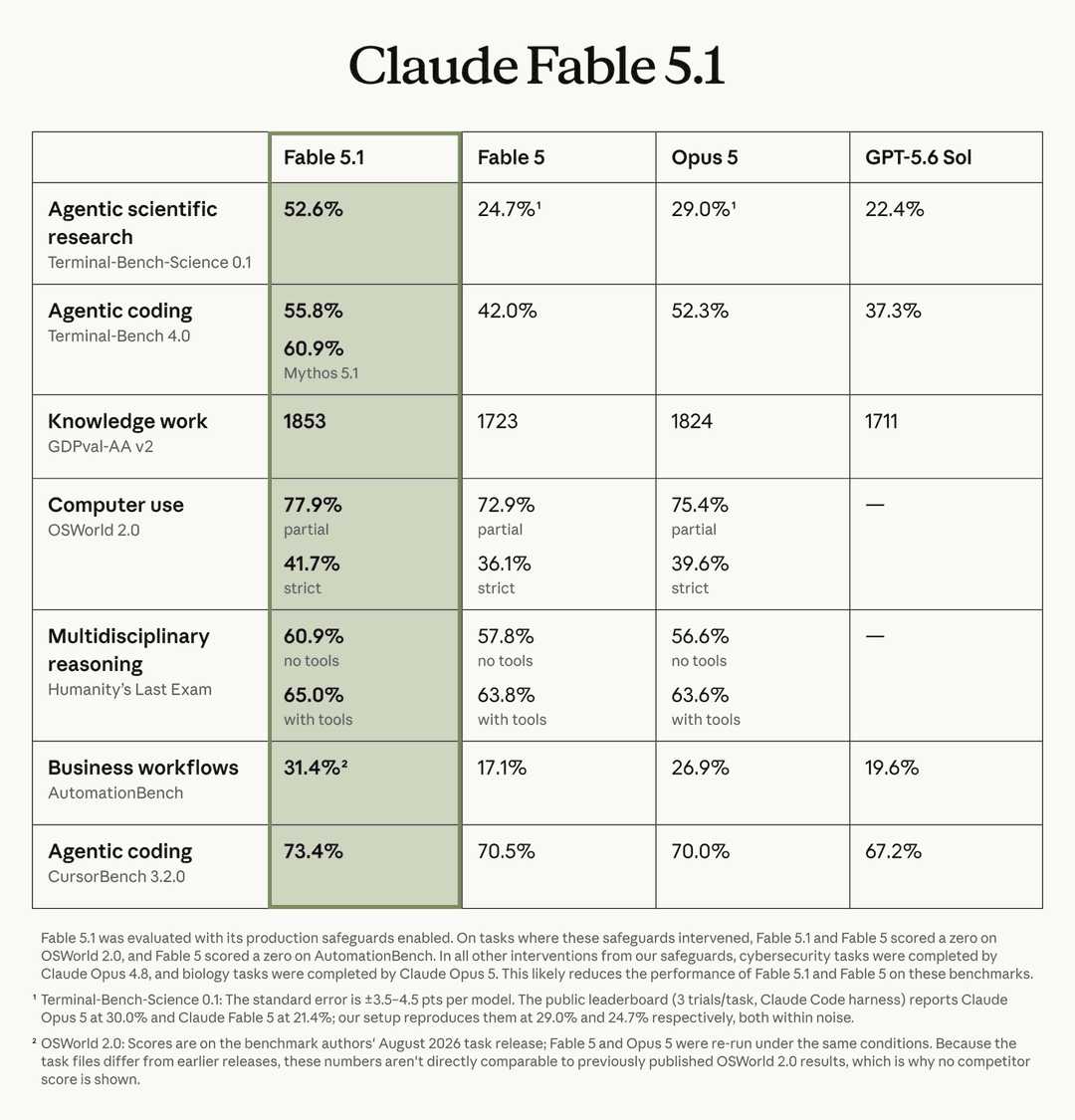
Those are real gains. But look at the rows where Fable 5.1 is racing Opus 5 instead of its own predecessor, and the gap narrows to a few points almost everywhere: 55.8% against 52.3% on agentic coding, 60.9% against 56.6% on Humanity's Last Exam without tools. Fable 5.1 is the better model on paper, consistently, but it isn't lapping the field. Don't build an opinion off the top row alone.
The cost curve is the more interesting chart
The chart I keep coming back to is the CursorBench cost-per-task curve, plotted at every reasoning effort tier from low to max, on a log scale.
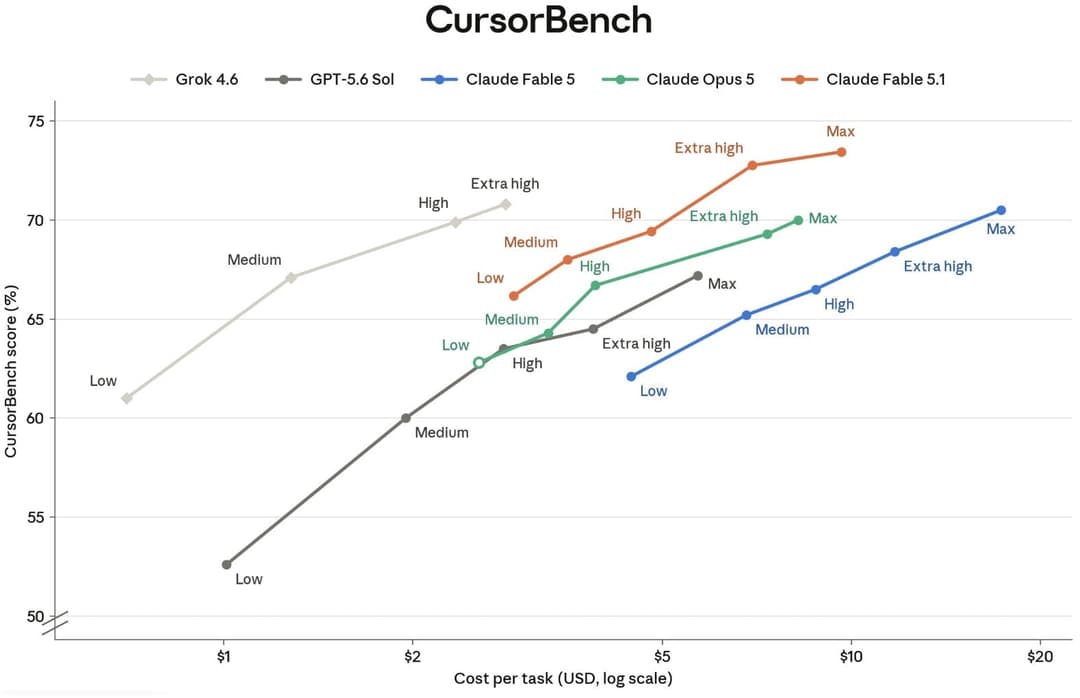
At its maximum effort setting, Fable 5.1 scores 73.4%, up from Fable 5's 70.5% at Fable 5's own maximum effort and ahead of Opus 5's 70.0%, and it gets there at roughly half the price Fable 5 needs to hit its own top score. The curve moved up and to the left at the same time, which is harder than just getting smarter. Against Opus 5 specifically, it holds at every effort tier on the chart, not only at the maximum setting: Fable 5.1's curve sits above Opus 5's the whole way across.
If you tune a scraping or extraction agent's model tier by hand, that's the number to remember over the leaderboard rank. A pipeline that was eating the cost of Fable 5 at a high effort setting to hit a quality bar might clear that same bar at a noticeably lower effort setting on Fable 5.1, for real savings on every call, not a one-time win.
Where GLM-5.3-Flash lands
While Anthropic was moving the top of the curve, Zhipu was doing something more interesting at the bottom of it. GLM-5.3-Flash, a 320-billion-parameter mixture-of-experts model with 18 billion active parameters, scores 57 on the Artificial Analysis Intelligence Index, four points behind GPT-5.6 Sol's 61 and just 3 points behind its own bigger sibling, GLM-5.3, at what Artificial Analysis measured as roughly 7.5 times lower cost per task. It landed on their intelligence-versus-cost Pareto frontier at launch, list priced at $0.15 per million input tokens and $0.50 per million output tokens, open weights, MIT licensed, on Hugging Face the same day it shipped.
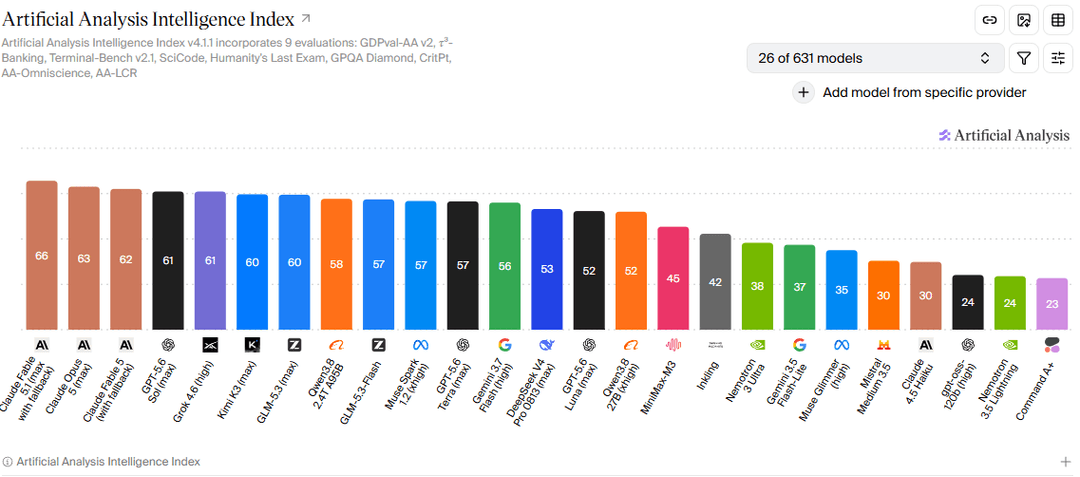
That's the other half of the story: a model cheap enough that running it barely shows up as a line item, and good enough that it stops being an obvious downgrade for most everyday agent calls. There's also the cost to run the entire Intelligence Index, which shows Fable 5 and Fable 5.1 at the expensive end and GLM-5.3-Flash near the bottom, though that chart measures the bill for a whole benchmark suite, not the price of any single call, so I won't lean on its exact dollar figures here.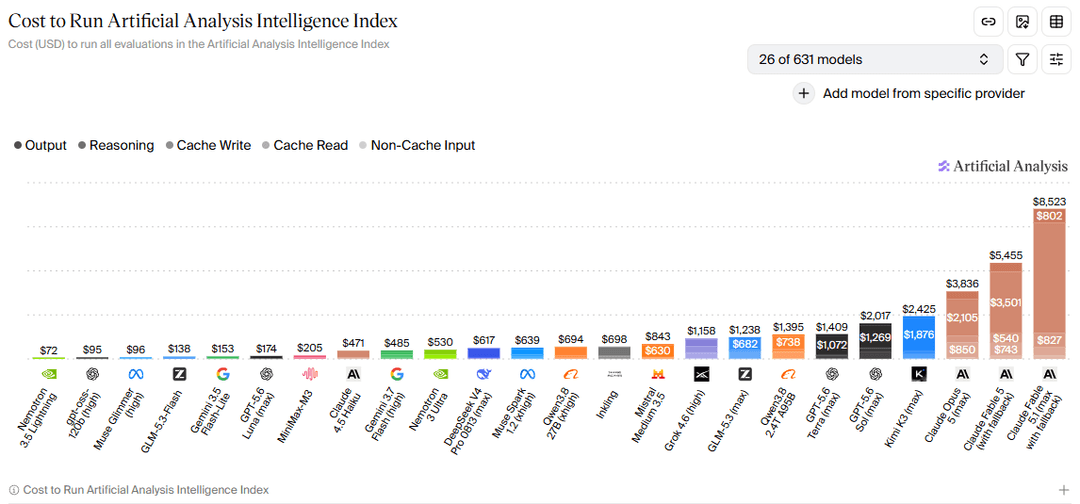
I ran it through a real extraction job
Leaderboard scores are one thing. I wanted a number from my own pipeline, so I pointed GLM-5.3-Flash at a real product page and asked it to pull eight fields out as structured JSON.
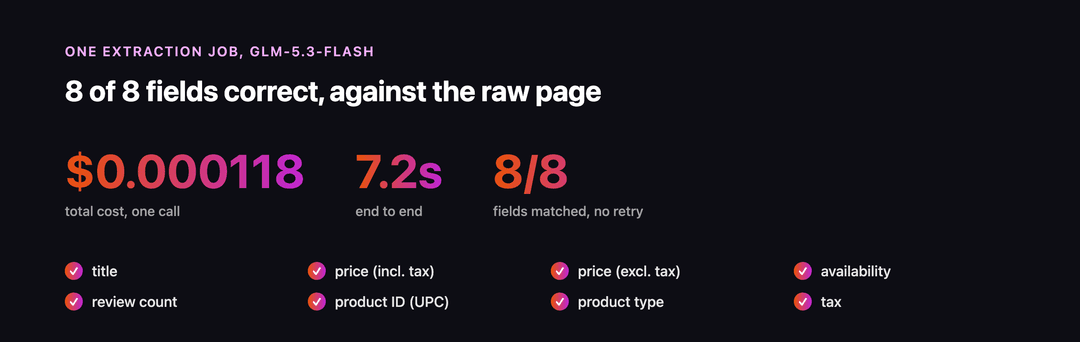
It got all eight right, matching the page exactly, for a total cost that rounds to a tenth of a cent. One page, once, not a benchmark run, so treat it as a spot check and not a claim about the model in general. But it's the kind of call that makes up most of the volume in an extraction pipeline, and it's reassuring to see a model this cheap handle it cleanly on the first try instead of needing a retry or a schema nudge.
The cache discount depends on your agent's shape
Anthropic also cut the price of a prompt cache read on Fable 5.1 by 75%, from $1.00 to $0.25 per million tokens, leaving base input and output pricing unchanged at $10 and $50 per million. VentureBeat reported that Anthropic itself frames the real-world impact as roughly 25% off a typical workload's bill, rising to as much as 45% for heavily agentic tasks. That's the honest number. Don't round it up to "everything got 75% cheaper."
A single-shot extraction call has a small cacheable prefix, usually just the schema and the instructions, so a 75% discount on a small number doesn't move the bill much. A multi-turn scraping agent that re-sends its accumulated context, including every page it has already fetched, is a different shape entirely: that cacheable prefix grows every turn, and the discount compounds with it. If your agent looks more like the custom fetch tool work I wrote up in the Harness Engineering series, where fetched pages accumulate in context across a multi-step loop, measure this on your own traffic before assuming the 75% headline applies.
I'd met GLM-5.3-Flash before, I just didn't know its name
An anonymous free model calling itself "Ox Alpha" showed up on OpenRouter and opencode zen on August 20, its identity scrubbed against every direct question I threw at it, and it would be another six days before the world had a name for it. I went looking anyway, using the kind of evidence a model can't easily hide: provider-side error codes that matched Zhipu's own published API documentation verbatim, a temperature parameter capped at 1 rather than the wider range OpenAI and Anthropic allow, a max output token ceiling of 131,072 that lines up with GLM's known context window, and a response envelope shape that matched Zhipu's schema field for field.
I put my notes together on August 21, the day after the model first appeared, and tweeted the guess that same afternoon.
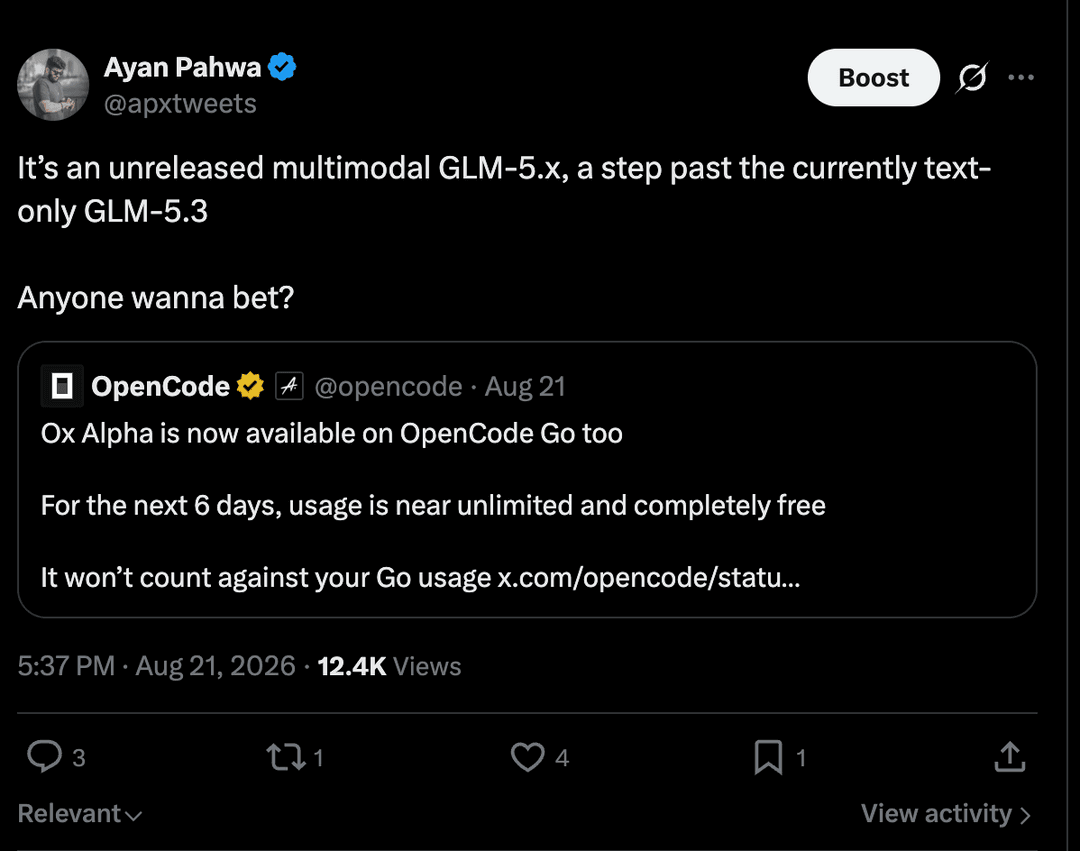
Posted 5:37 PM, August 21, 2026, quote-tweeting OpenCode's own announcement that Ox Alpha had landed on OpenCode Go that day. The tweet is still up.
I didn't have the name GLM-5.3-Flash to give it, since that name wouldn't exist for another six days. What I called was the shape of it: an unreleased GLM model, multimodal rather than text-only, a step past the GLM-5.3 that had shipped as text-only a week earlier. Zhipu confirmed both on August 27.
I won't pretend that was certainty. It was a bet I was willing to post publicly, and it landed. Its self-reported knowledge cutoff was wrong the whole time, for what that's worth. What I'd actually stand behind is the method, not the guess: when a model's identity is deliberately scrubbed, the things it doesn't control, its error messages, its parameter bounds, its response format, tell you more than anything it says about itself.
What I'm actually doing differently
If you're running scraping or extraction agents today, the practical read is simple. Fable 5.1 is worth a look for the genuinely hard stuff: agentic coding, long multi-step extraction flows, anything where a wrong answer is expensive to catch downstream. Test it at a lower effort tier than you'd have used on Fable 5; the curve suggests you may be able to drop a tier and still come out ahead on quality.
GLM-5.3-Flash, or something in its price class, is where the routine calls belong: field extraction off a known page structure, classification, the steps that make up most of an agent's turns and none of its hard decisions. And measure the cache discount against your own agent's shape rather than assuming the 75% headline applies uniformly.
I didn't have to rebuild anything overnight, which is probably the real news. The models keep getting better and cheaper from both directions at once, and the job is mostly picking which end of the curve a given task needs.