
Every other access control mechanism described in Zyte's State of Web Access 2026 research operates on content or behavior:
- WAFs inspect HTTP requests.
- CAPTCHAs challenge users after a page loads.
- Antibot systems analyse session behavior over time.
- Rate limiting fires after a threshold is crossed.
- JavaScript challenges by not rendering content at all.
TLS (Transport Layer Security) fingerprinting is different. It fires before any of that happens - before an HTTP request is made, before a URL is requested, before any content changes hands.
This method operates at the cryptographic handshake layer: the negotiation that establishes an encrypted connection. By the time the server has even seen what page you're asking for, a TLS fingerprinting system may have already decided whether to let you in.
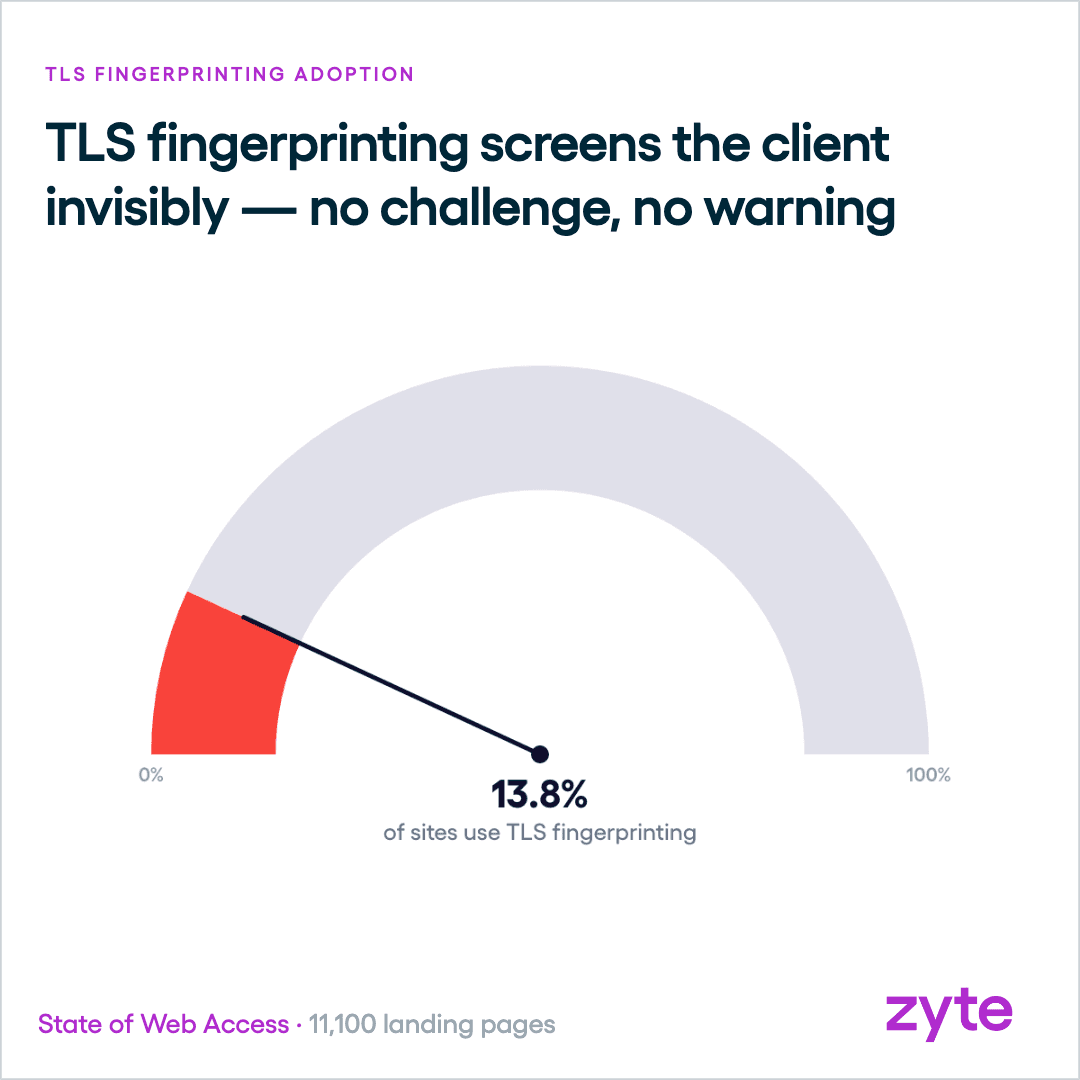
Adopted by 13.8% of the world's 11,100 most popular sites, according to State of Web Access 2026, it is the least common of the six barriers we measured. It is also, in some ways, the most architecturally distinctive - and the one that offers the least feedback when it fires.
How TLS fingerprinting works
When a client connects to a server over HTTPS, a negotiation happens before any encrypted data flows. The client announces:
- Which TLS versions it supports.
- Which cipher suites it can use.
- Which cryptographic extensions are available.
This announcement is sent in the clear - it must be, because encryption hasn't been established yet.
The combination of parameters a client presents in this handshake is characteristic. Chrome announces one set of capabilities, Firefox announces a slightly different set, Python's requests library has its own pattern, while Go's default HTTP client has another. A headless Playwright instance running in a Docker container has its own distinctive signature, different again from a real Chrome browser on a MacBook.
These signatures are stable enough to be fingerprinted reliably.
In 2017, researchers at Salesforce published JA3 - a method for hashing the TLS client hello parameters (TLS version, cipher suites, extensions, elliptic curves, elliptic curve point formats) into a 32-character digest.
JA3 hashes can be compiled into blocklists: any connection presenting a hash matching a known automation library gets dropped at the handshake, before a single HTTP byte is exchanged. JA4, published in 2023, extends the approach with directional awareness and support for newer protocols, but the core insight is the same: automated clients and real browsers look different at the protocol layer.
Detection is invisible to the client itself. Unlike a 403 Forbidden HTTP response or a CAPTCHA challenge page, a TLS-layer block typically results in a connection refused or a TCP reset. There is no error message explaining what happened. The client learns only that the connection failed - not why.
13.8% with an asterisk
The 13.8% figure deserves a caveat: it is probably an undercount.
Vendor attribution was possible for only 689 of the 1,531 sites where TLS fingerprinting was detected - 45%. The remaining 55% showed fingerprinting behavior without a named-service signature that could be attributed to a specific product. Some of that is Cloudflare WAF operating below the Bot Management tier, implementing JA3 checks through firewall rules without the full product footprint. Some is custom configuration at the load balancer or reverse proxy layer - nginx and HAProxy can both be configured to check JA3 hashes against blocklists with no commercial product involved. Some is Akamai or Fastly edge functions running bespoke logic.
TLS fingerprinting, unlike CAPTCHA or antibot, doesn't require buying a vendor product. Any infrastructure operator with access to the TLS handshake can implement it. The 13.8% measures what we could detect; the true deployment rate is higher.
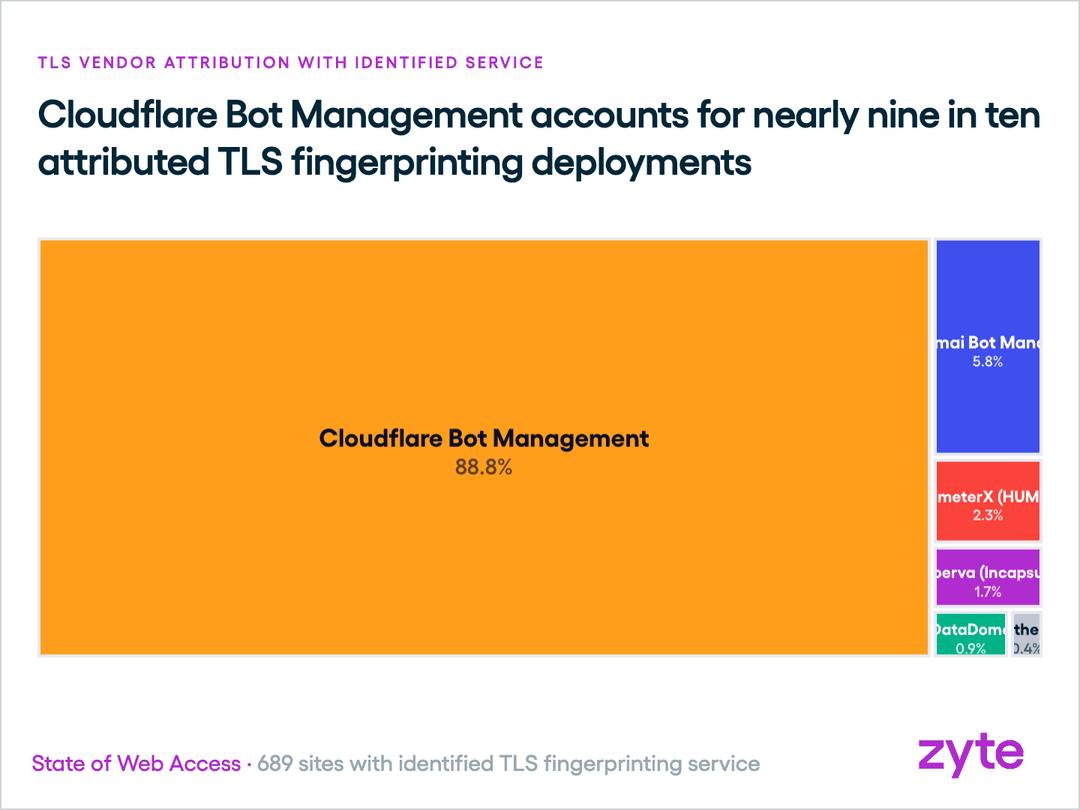
Among the identified vendors, the pattern is familiar: Cloudflare Bot Management accounts for 88.8% of attributed detections. Akamai Bot Manager takes 5.8%, PerimeterX/HUMAN 2.3%, Imperva 1.7%. The Cloudflare concentration is even higher here than in the antibot data - TLS fingerprinting is more deeply embedded in the Cloudflare platform than any other single capability.
TLS and rate limiting work as a pair
The co-occurrence picture for TLS fingerprinting is the most extreme in the dataset.
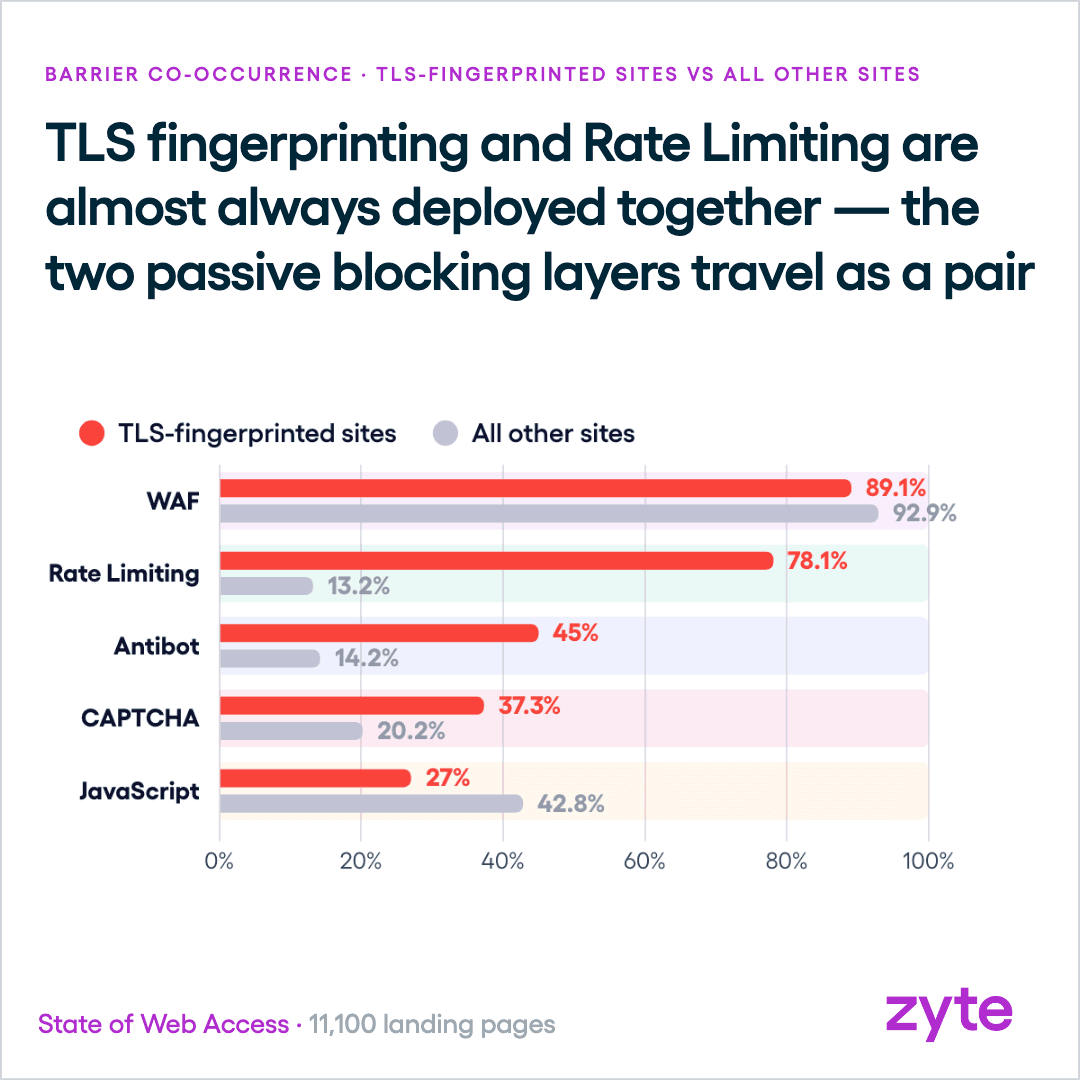
Rate limiting appears on 78.1% of TLS-fingerprinting sites, versus just 13.2% of all other sites - a sixfold gap that is the sharpest differential between any two barriers measured across the entire research.
The pairing has a logical architecture behind it:
- TLS fingerprinting screens at the connection layer: known automation signatures are refused before they reach the HTTP stack.
- Rate limiting then catches anything that passes the handshake check - a client that spoofed or rotated its TLS fingerprint successfully but whose request frequency or IP reputation then triggers the quota layer.
The two passive blocking mechanisms form a sequential filter, each addressing the failure modes of the other.
This is a deliberate infrastructure investment. Sites running both TLS fingerprinting and rate limiting have thought about the problem in layers: what does network-level screening miss, and what does quota-based blocking miss, and how do we stack them so the gaps don't overlap? That kind of systematic thinking shows up clearly in the rest of the co-occurrence data: 45% of TLS sites also run antibot, 37.3% run CAPTCHA.
One counter-intuitive finding: TLS-fingerprinting sites are notably less likely to require JavaScript rendering (27%) than all other sites (42.8%). The same logic applies here as in the JavaScript article's TLS inversion - sites committed to server-side, protocol-layer screening have less need for client-side behavioral signals. The network layer and the JavaScript layer are addressing the same underlying question from different positions in the stack, and operators who have invested heavily at the network level have less reason to rely on the browser level.
The same sectors that top the rate-limiting list
The industry distribution for TLS fingerprinting closely tracks the rate limiting leaderboard.
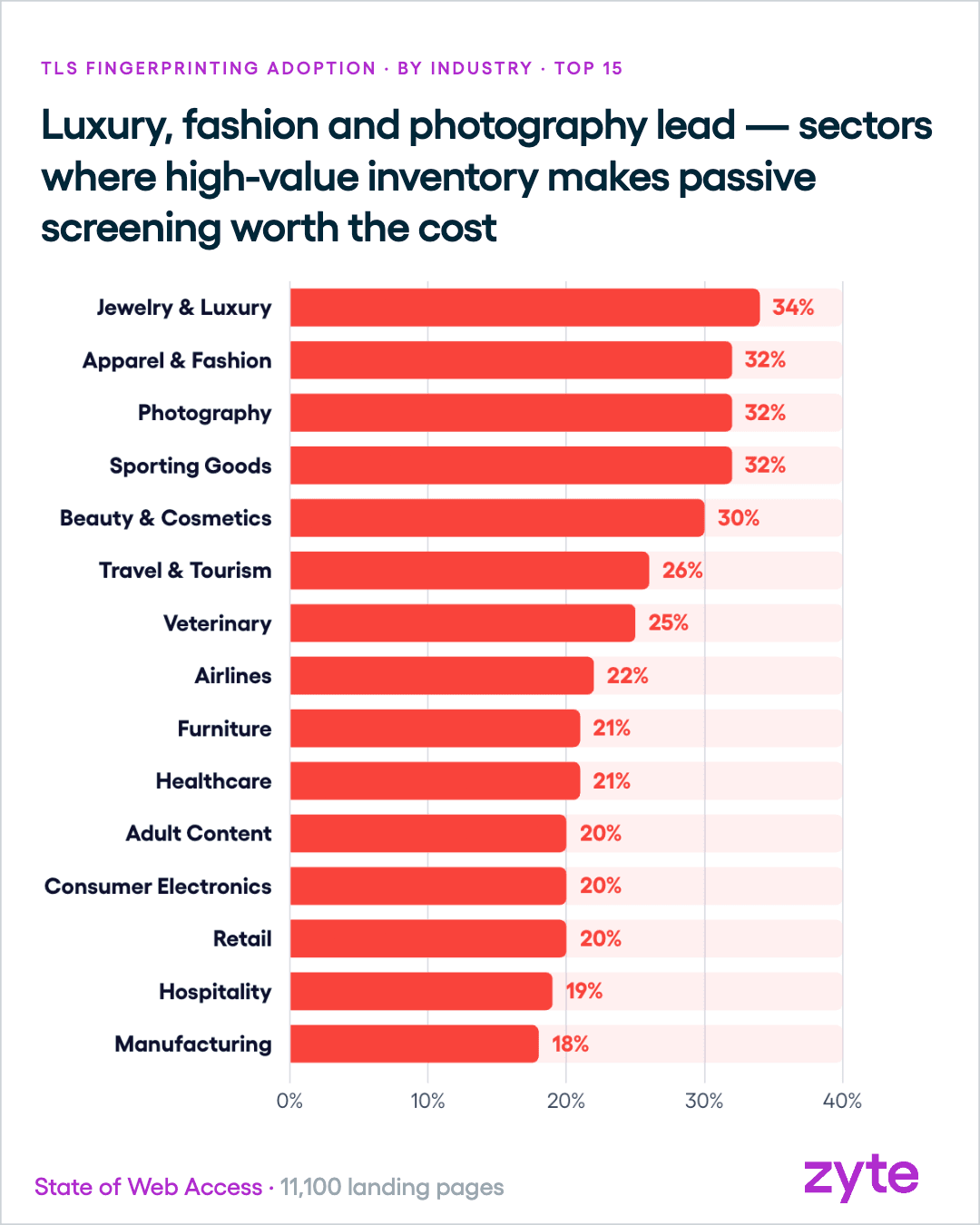
Jewelry and luxury products lead at 34%, apparel and fashion at 32%, photography at 32%, sporting goods at 32%, beauty and cosmetics at 30%.
These are the same sectors - high-value inventory, competitive intelligence pressure, volatile pricing - that led on rate limiting. The overlap is not coincidental. TLS fingerprinting and rate limiting share an audience: operators who have concluded that a single barrier layer is insufficient and have invested in infrastructure-level access control across multiple dimensions simultaneously. Rather than choose between TLS fingerprinting and rate limiting, they deploy both, along with antibot and CAPTCHA, as components of a deliberately constructed stack.
At the other end of the distribution, the logic of openness is equally clear. TLS fingerprinting would be self-defeating for these operators. Information-first sectors depend on crawler access for distribution - search indexing, news aggregation, academic discovery. Screening automated clients at the connection layer would cut off the systems that sustain their visibility.
What TLS-fingerprinted sites cost to access
TLS fingerprinting is a compounding barrier in a specific sense: the sites that deploy it are almost never running it alone, and their overall access requirements reflect that.
TLS-fingerprinted sites require Advanced-tier Zyte API infrastructure - full browser emulation with fingerprint evasion - three times more often than other sites (2.2% versus 0.7%).
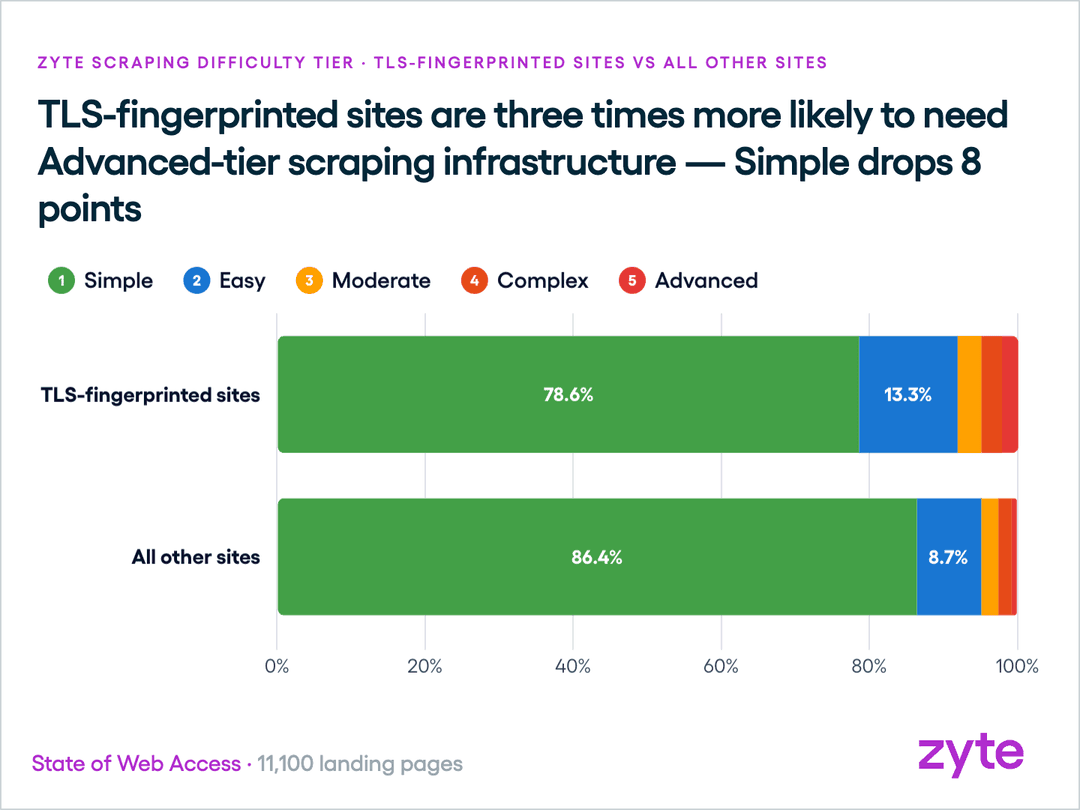
The uplift across the Moderate and Complex tiers is also visible. The explanation is structural: a site running TLS fingerprinting has signaled a level of investment in access control that virtually always comes with additional layers. When the TLS barrier is bypassed, there is almost always something else waiting behind it.
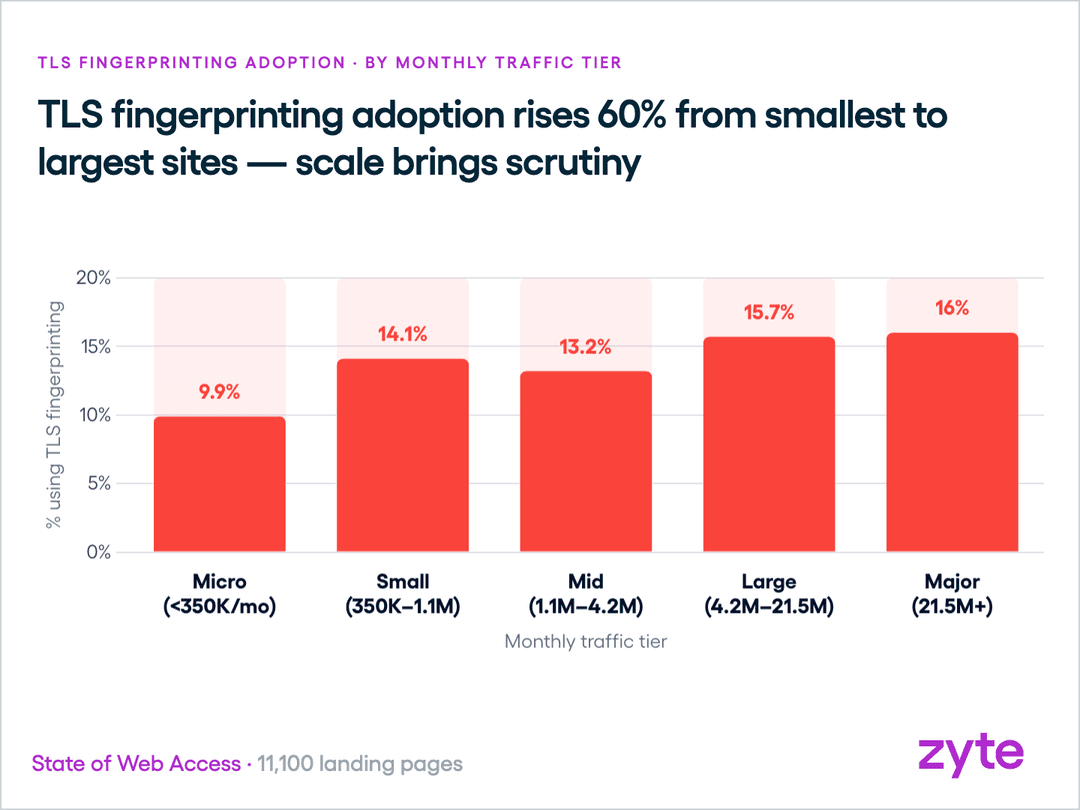
Adoption also scales clearly with site traffic: 9.9% for micro sites (under 350,000 monthly visits) rising to 16.0% for major sites with 21.5 million or more - a 60% lift across the scale bands.
TLS fingerprinting requires operational investment to configure and maintain, and the economics only make sense at the scale and data value where systematic scraping pressure actually materialises.
The silence is the hardest part
In practical terms, TLS fingerprinting is the barrier most likely to produce confusing failure modes.
- When a CAPTCHA blocks you, you see a CAPTCHA.
- When rate limiting fires, you get a
403. - But, when TLS fingerprinting drops a connection, you typically get silence: a connection timeout, a TCP reset, a
curlerror with no HTTP response at all.
The blocked client has no information about what happened, and misdiagnosis is common - network problems, server outages, and TLS fingerprint blocks can look identical from the client side.
That invisibility is the property's core value for operators: a blocked automation client can't adapt to feedback it never receives. It is also the property that makes TLS fingerprinting the hardest barrier in the stack to diagnose when you're on the wrong side of it. You can't fix what you can't see.
Understanding whether a site is TLS fingerprinting requires testing with multiple client stacks - comparing a plain Python HTTP request against a real browser request against a known TLS-impersonation library - and inferring from the differential whether the connection layer is the problem.
It is the most technically demanding diagnostic in the web access stack, for a barrier that accounts for 13.8% of landing pages and a meaningfully higher share of the sites where access actually matters.