Anyone who has built a scraper knows the relief of a site that just behaves. You send a plain request and the whole page comes back. There's no browser to launch, no script to wait for, and the hundredth visit goes exactly like the first.
Those sites still exist, and Zyte's State of Web Access 2026 research, which audited 11,100 of the world's most popular landing pages, shows where to find them. They aren't scattered at random. They belong to organizations that want their pages read, by people and by machines alike.
What makes a website easy to scrape?
An easy site hands over its content without conditions. The study looks for six ways a site can make that harder: a web application firewall tuned against automated clients, an antibot service scoring each visit, a CAPTCHA, content that only appears once JavaScript runs, rate limiting that blocks a client outright, and TLS fingerprinting that screens connections before a page is even requested.
A site that runs none of the six counts as open. Its page arrives complete over plain HTTP, and nothing on the way in asks who's knocking. Many of these sites do sit behind a generic, unidentified firewall layer from their hosting provider, but nothing the study could attribute to a product or a deliberate policy.
Which websites are easiest to scrape?
The most open corners of the web are the ones with something to publish rather than something to sell. More than a third of military and public policy sites in the study ran none of the six barriers. Science sites were close behind at 34%.
Then comes a cluster that might seem an odd mix at first: chemicals and government at 32%, then education, reference and public relations at 31%. Civil engineering, nanotechnology and plastics and polymers each come in at 30%.
What links a ministry, an encyclopedia and a polymer supplier is that their pages exist to be found. Compare that with furniture, where just 3% of sites are open, or apparel and fashion at 6%. Retailers publish prices that competitors want to track. A government department publishes notices it would be happy to see everywhere.
The most open categories:
| Category | Sites with no barriers |
|---|---|
| Military | 35% |
| Public policy | 35% |
| Science | 34% |
| Chemicals | 32% |
| Government | 32% |
| Education | 31% |
| Reference | 31% |
| Public relations | 31% |
And the least open:
| Category | Sites with no barriers |
|---|---|
| Furniture | 3% |
| Veterinary | 4% |
| Apparel and fashion | 6% |
| Beauty and cosmetics | 7% |
| Jewelry and luxury | 7% |
| Wellness | 7% |
| Tobacco | 8% |
| TV and movies | 8% |
Zoom out to Zyte's 20 industry groups and the public sector comes out as the most open part of the web, with nearly three in ten sites running none of the barriers. The groups that trade in prices and listings sit at the bottom.
| Industry group | Sites with no barriers |
|---|---|
| Public sector | 29.2% |
| Education | 25.4% |
| Manufacturing and logistics | 23.2% |
| Energy and utilities | 23.0% |
| Technology | 21.3% |
| ... | ... |
| Automotive | 13.0% |
| Retail and e-commerce | 12.3% |
| Real estate | 11.0% |
Why are government websites so easy to scrape?
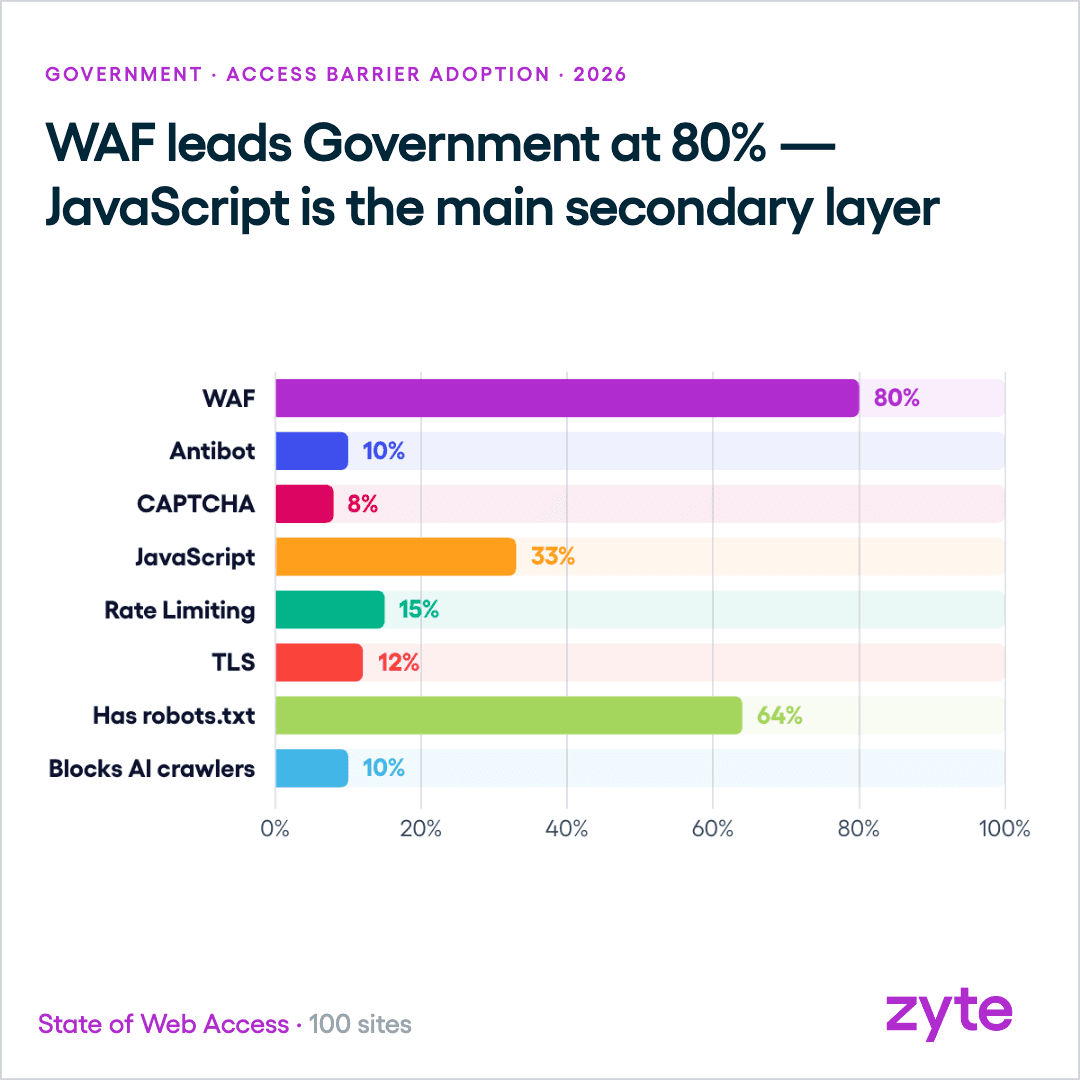
Partly because they're expected to be. Public bodies run the lightest defensive setup of any industry group in the study. Only one government site in ten runs an antibot service, and fewer than one in ten shows a CAPTCHA.
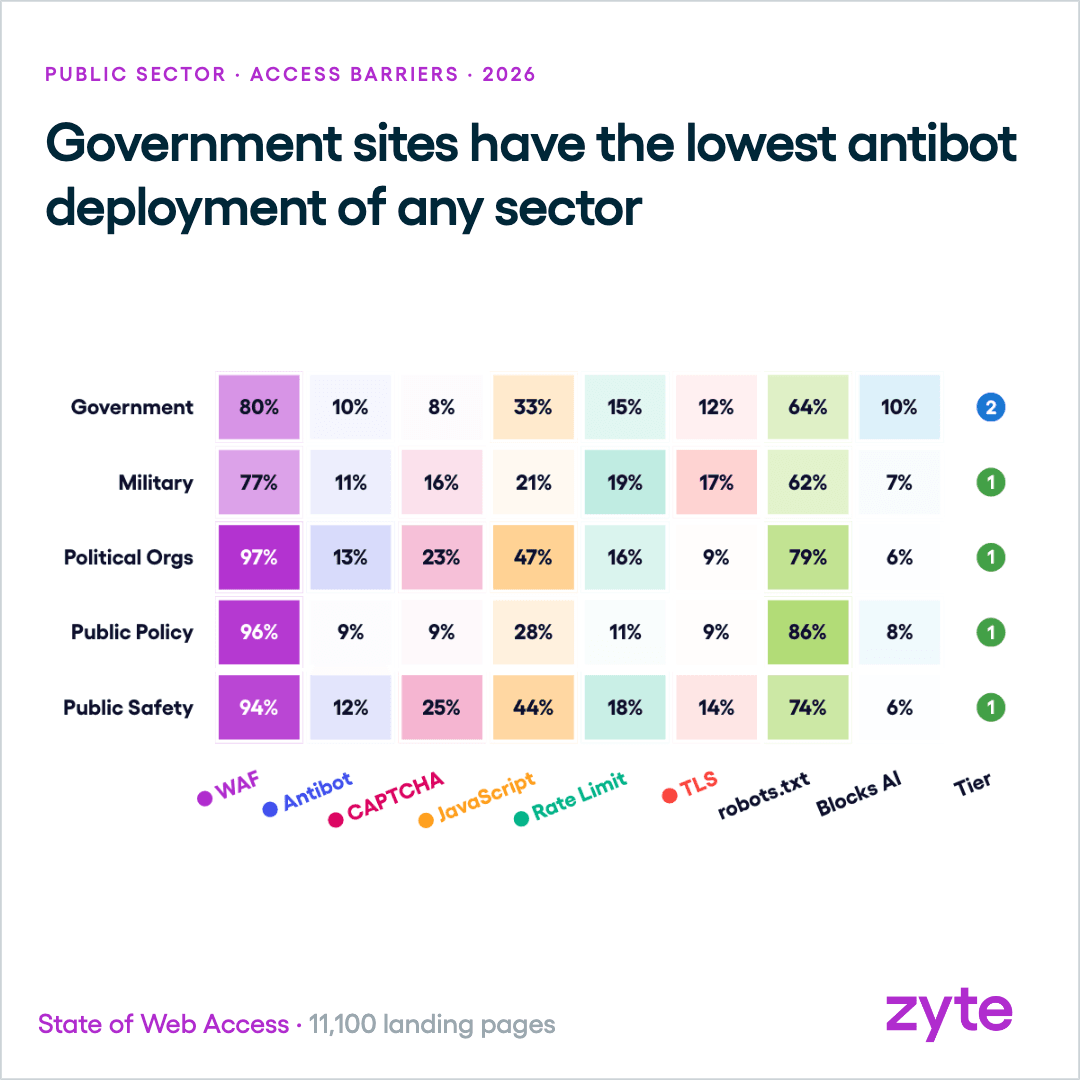
Where government sites do add a layer, it is usually JavaScript, a byproduct of modern web design rather than a defense. A third of government sites need it, while rate limiting and TLS fingerprinting each appear on fewer than one in six.
Some of that openness is written into law. In the US, the OPEN Government Data Act, signed in 2019, requires federal agencies to publish public data in machine-readable form by default. In Europe, the Open Data Directive obliges public bodies to make designated high-value datasets free to reuse, in machine-readable formats and through APIs.
A government website that fought off automated readers would be working against the rules it lives under. For many agencies, the website is simply the first place a piece of public information appears, and reuse is the point.
Why do science and reference sites stay open?
Their whole purpose is to be cited, indexed and passed along. A research institute or a reference publisher that locked out machines would also lock itself out of the search engines and academic discovery tools that send it readers. Openness is how that content travels.
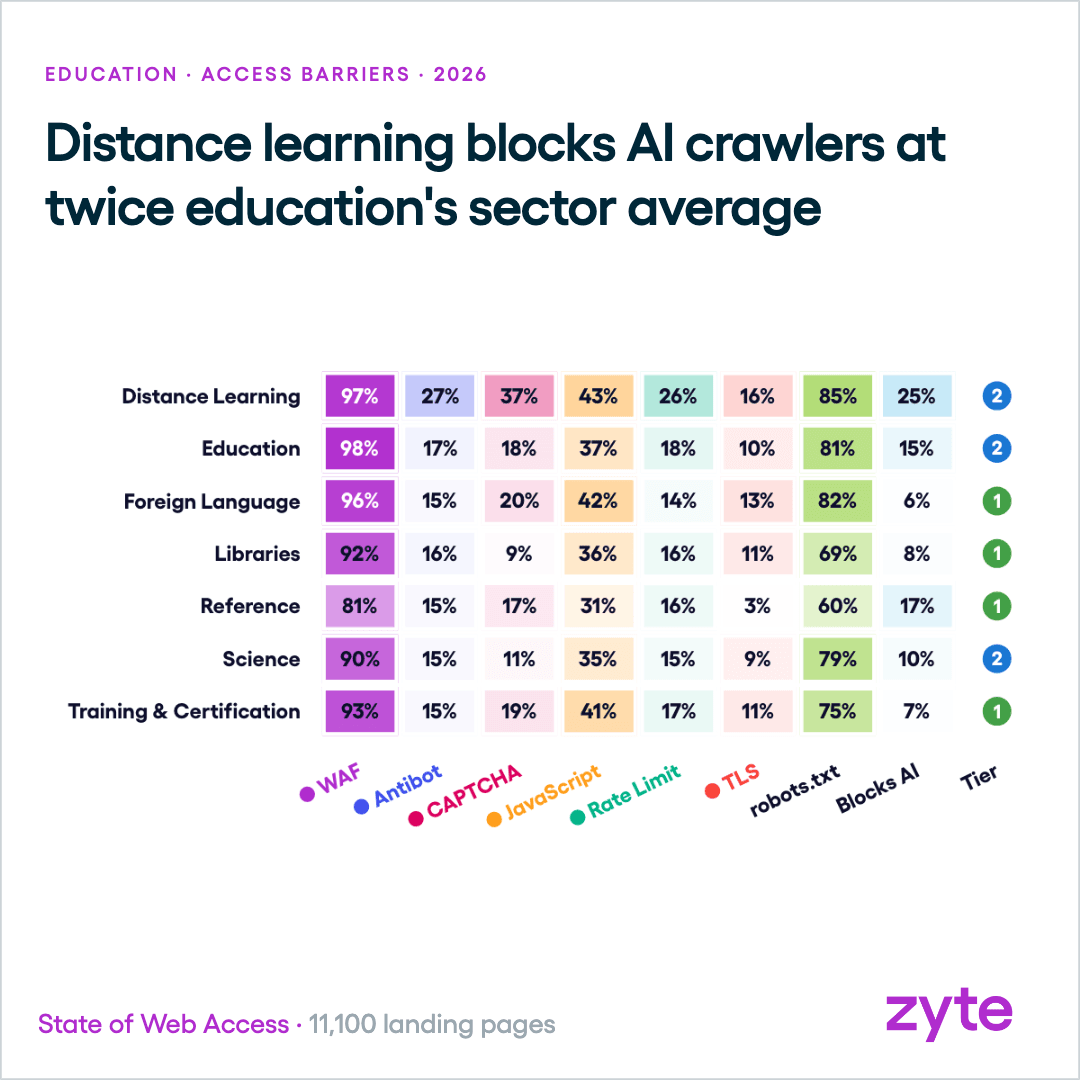
The education group's heatmap shows how light the touch is. Reference sites run TLS fingerprinting on just 3% of sites, and science sites show a CAPTCHA on only 11%.
Why are industrial supplier websites easy to scrape?
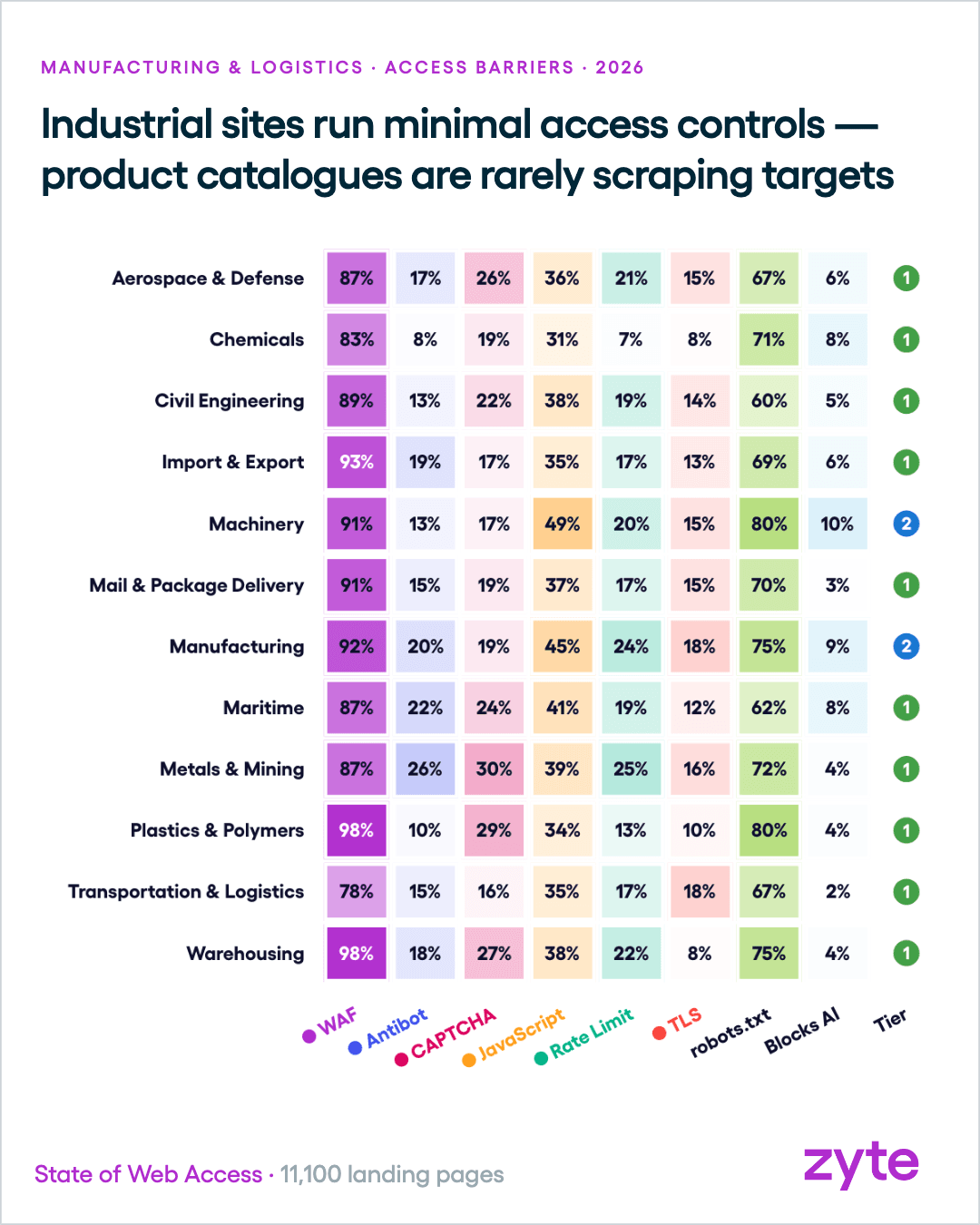
This is the most surprising cluster in the data. Chemicals makers, plastics suppliers, civil engineering firms and warehousing companies rank among the most open sites on the web, and the manufacturing and logistics group as a whole is the third most open of the 20.
These are business-to-business sectors, where an engineer or a buyer will read specifications, certifications and product ranges long before calling a sales rep. A product data sheet that search engines and procurement platforms can't read is a lead that never arrives. And unlike a retail price, a chemicals catalog changes slowly, so there's little competitive advantage in hiding it.
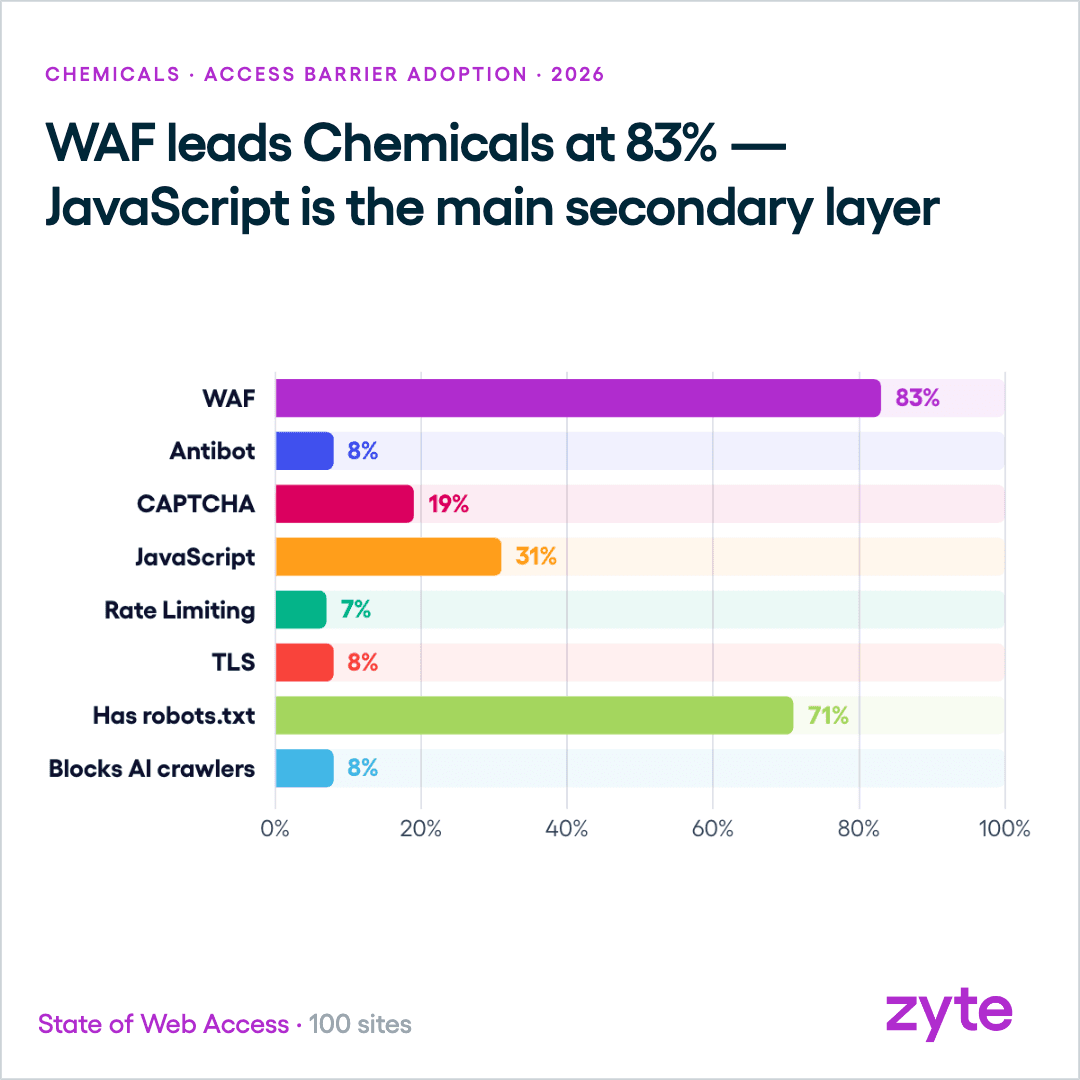
Chemicals makes the point most clearly. Only 7% of its sites rate-limit and 8% run antibot, among the lowest rates for any category in the study.
Are smaller websites easier to scrape?
Generally, yes. A quarter of sites with fewer than 350,000 monthly visits run none of the six barriers. That share falls as traffic grows, then levels off once sites pass about 1.5 million visits a month.
| Monthly visits | Sites with no barriers |
|---|---|
| Under 350,000 | 24.6% |
| 350,000 to 1.5 million | 18.6% |
| 1.5 million to 4.2 million | 16.6% |
| 4.2 million to 21.5 million | 15.9% |
| Over 21.5 million | 16.6% |
It's the mirror image of how deliberate defenses spread. Controls like rate limiting and TLS fingerprinting become more common as sites grow, because bigger sites hold more valuable data and draw more automated traffic.
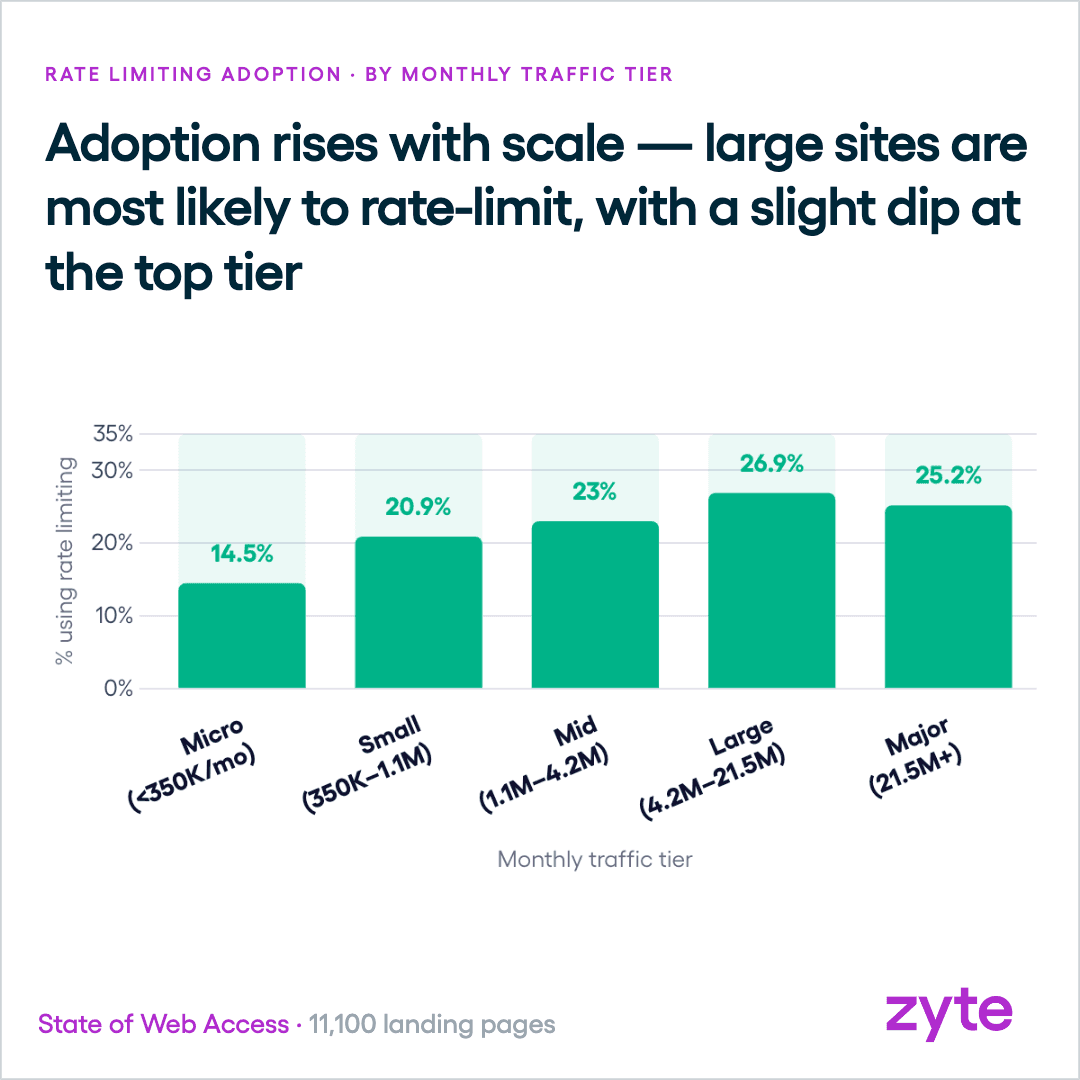
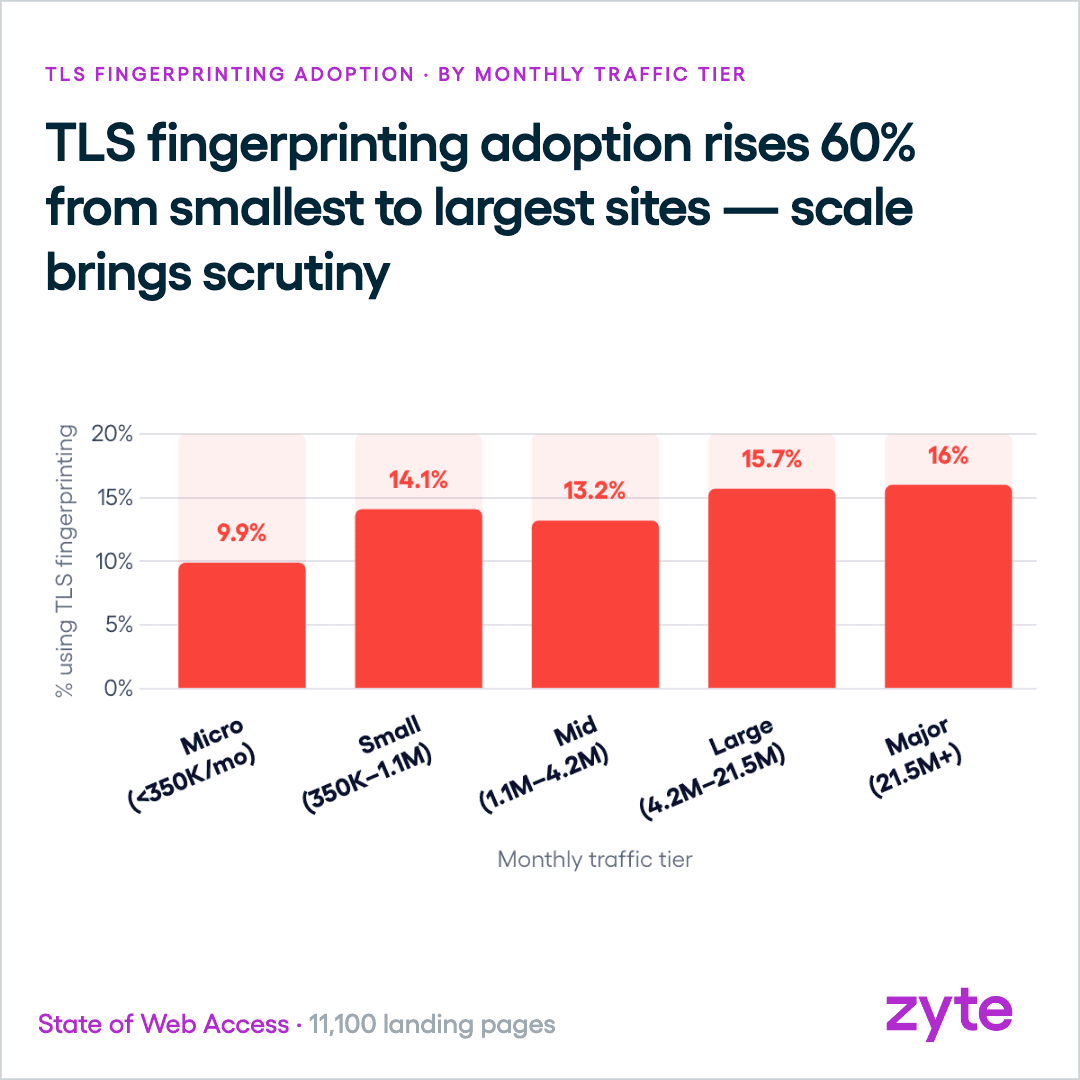
Size doesn't guarantee a closed door, though. The study found 68 domains with more than 100 million visits a month whose landing pages showed no detectable barrier at all. Big platforms often keep the front page as open as possible for search engines and save their defenses for what sits behind it, so a welcoming homepage says little about the search results or listings deeper in the site.
Is an open website always easy to scrape?
Most of the time. Of the open sites that Zyte API has assigned a measured access complexity tier, 81% are Simple or Easy, meaning a plain HTTP request or a basic headless browser does the job.
The other 19% still needed more. Their friction came from something a landing-page scan can't see, such as deeper pages, session behavior or custom logic.
And sometimes a site that's technically wide open still asks you to go gently. One legal-sector site in the study ran none of the six barriers and rated at the Simple tier, yet its robots.txt asks crawlers to wait 86,400 seconds between requests. That's one page a day. Nothing enforces it, but the operator's wishes are there in writing for anyone who looks.
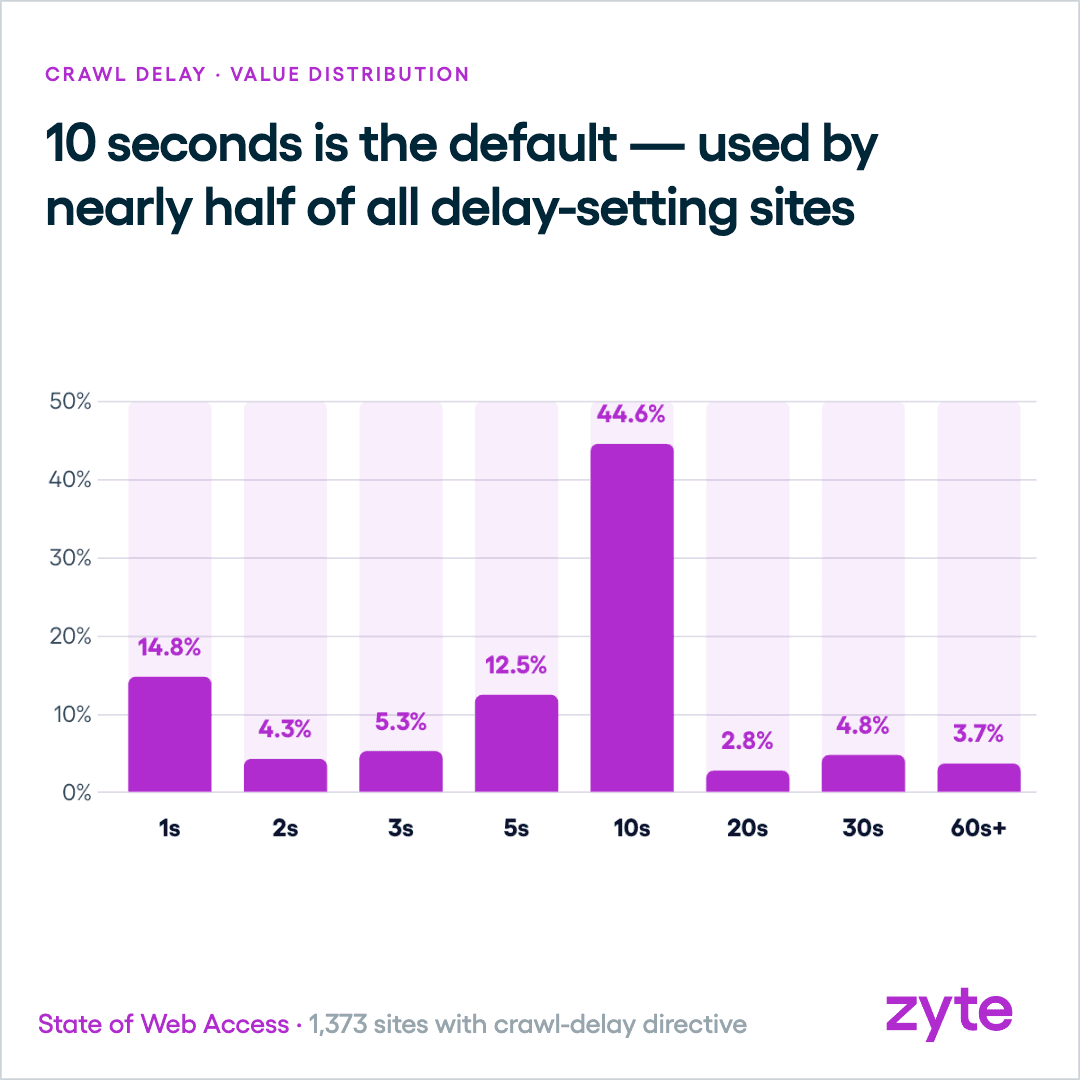
It's an extreme case. Among the sites that set a crawl delay at all, the most common request is a modest 10 seconds.
How can you tell if a website will be easy to scrape?
A few quick checks usually tell you what you're dealing with:
- Compare a plain request with what a browser shows. If the HTML from a simple HTTP request contains the content you can see on screen, you're probably looking at an easy site.
- Look for an official channel. Government bodies and scientific publishers often offer APIs or bulk downloads that are faster and more complete than the pages themselves.
- Read the robots.txt first. On open sites it's often the only statement of what the operator is comfortable with, and it's worth honoring, crawl-delay included.
- Don't judge a site by its homepage. An open landing page can sit in front of much better-defended search pages, accounts or listings.
- Match the tooling to the site. Zyte API's pricing charges for the difficulty a site actually presents, so the easiest sites cost the least to reach.
The easiest sites to scrape are rarely easy by accident. For the agencies, researchers and industrial suppliers behind them, being readable by machines is part of doing the job well.
Key takeaways: The easiest sites to scrape, in five numbers
Ease follows the need to be found:
- More than a third of military and public-policy sites run none of the six measured access barriers, the highest of any category.
- 32% of chemicals and government sites are open, against just 3% in furniture.
- 29% of public-sector sites are open, the highest of Zyte's 20 industry groups.
- 24.6% of sites with fewer than 350,000 monthly visits are open, against around 16% to 17% of larger sites.
- 81% of open sites with a measured Zyte API tier are Simple or Easy to access.