
Every property listing is a small advertisement. The photos, the floor plan and the asking price are all there to catch the eye of a buyer or a renter, and the agent behind the listing wants it in front of as many people as possible.
So real estate's place in Zyte's State of Web Access 2026 research may come as a surprise. Of the 110 industries measured, real estate ranks fourth for access complexity, behind only apparel and fashion, retail and sporting goods. Strip out the shops and it's the hardest industry on the web for a machine to read.
The average real estate site scores 2.38 on Zyte's five-point access complexity scale, well clear of the research-wide average of 1.58 and ahead of automotive, banking and every other part of the financial and professional economy.
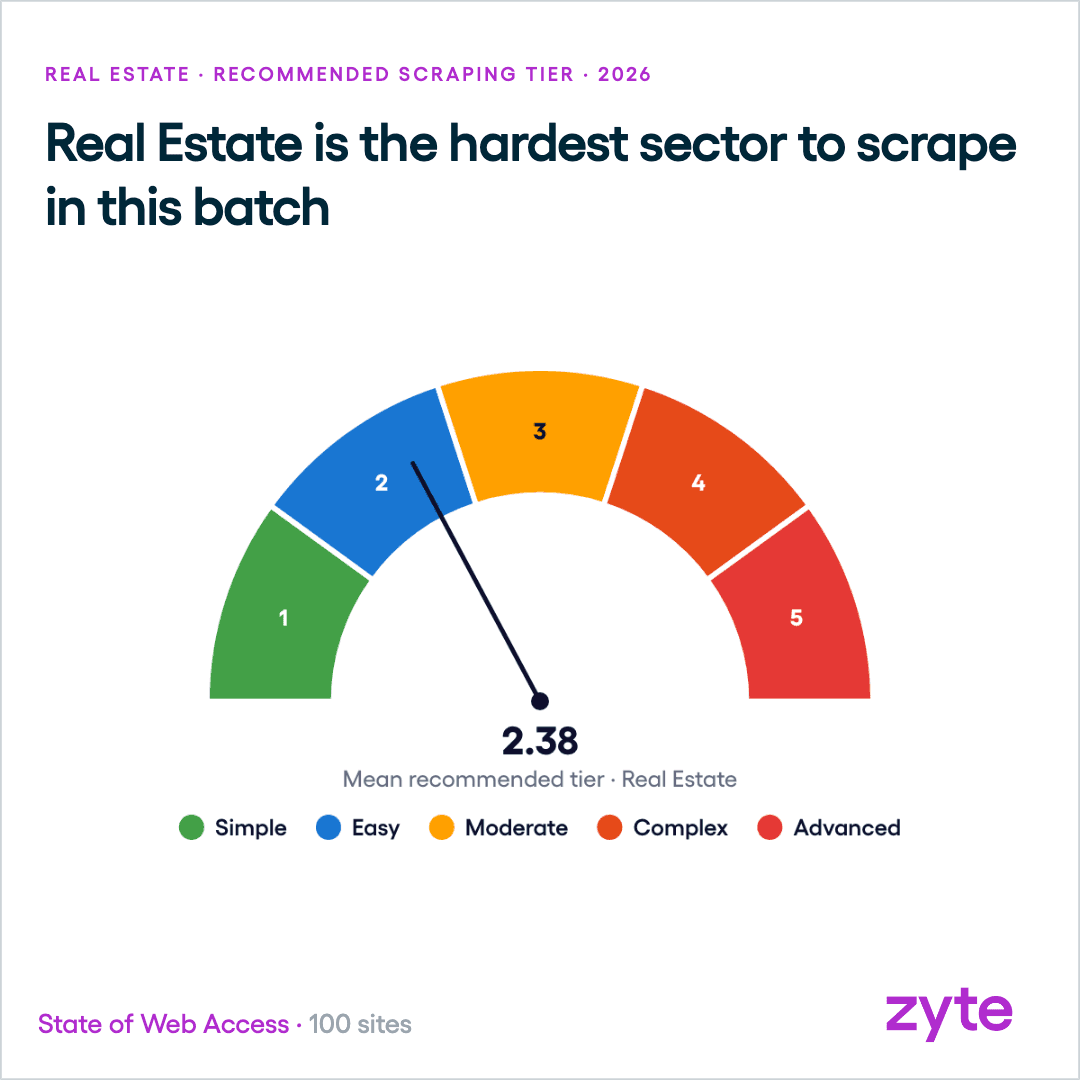
That tension, between listings built for exposure and sites built to resist collection, runs through the whole sector. The answer lies in who owns the listing. The agent wants it seen, but the portal that aggregates thousands of listings owns something more valuable than any single one: a complete, current picture of a housing market. That picture is what the defenses are protecting.
Why are real estate websites so hard to scrape?
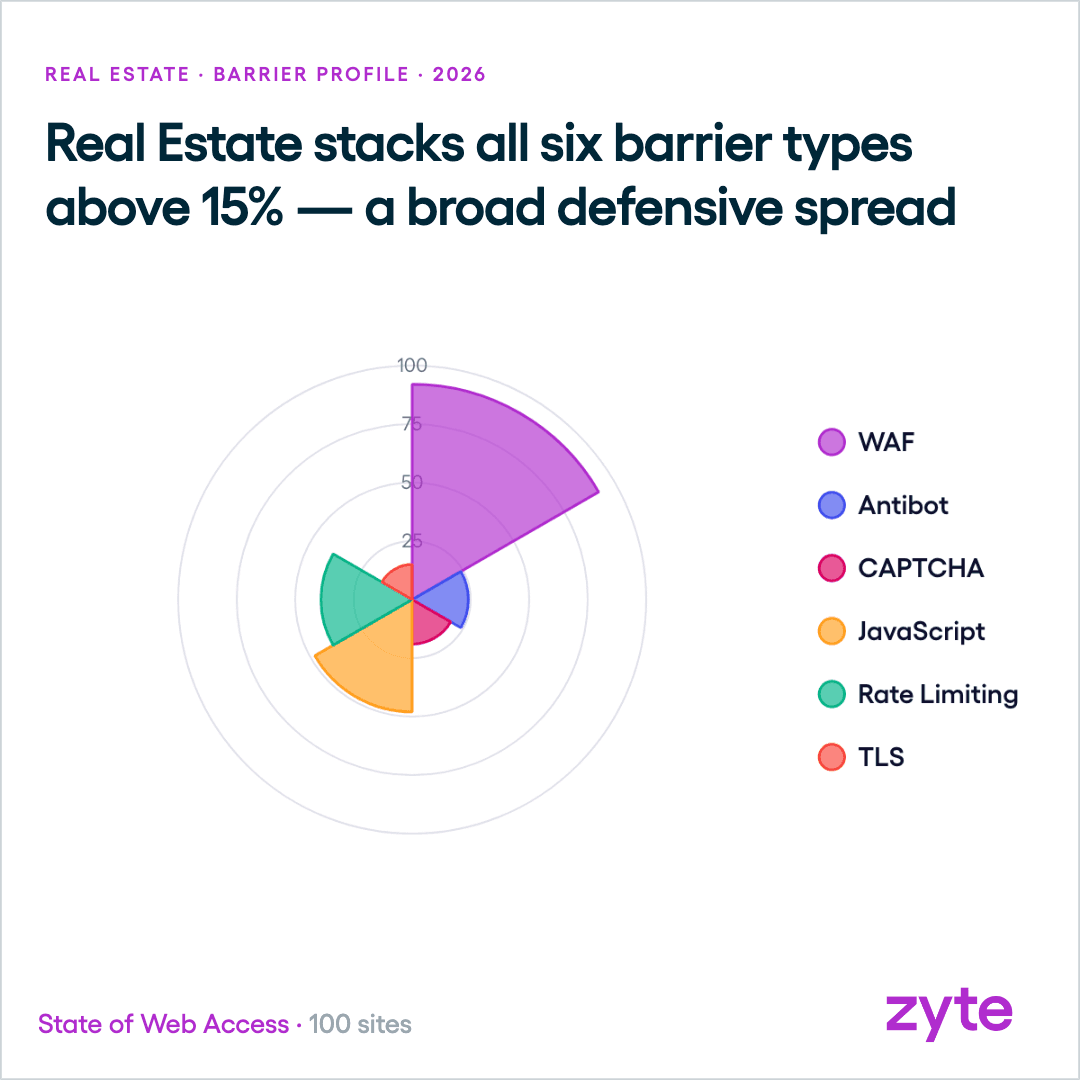
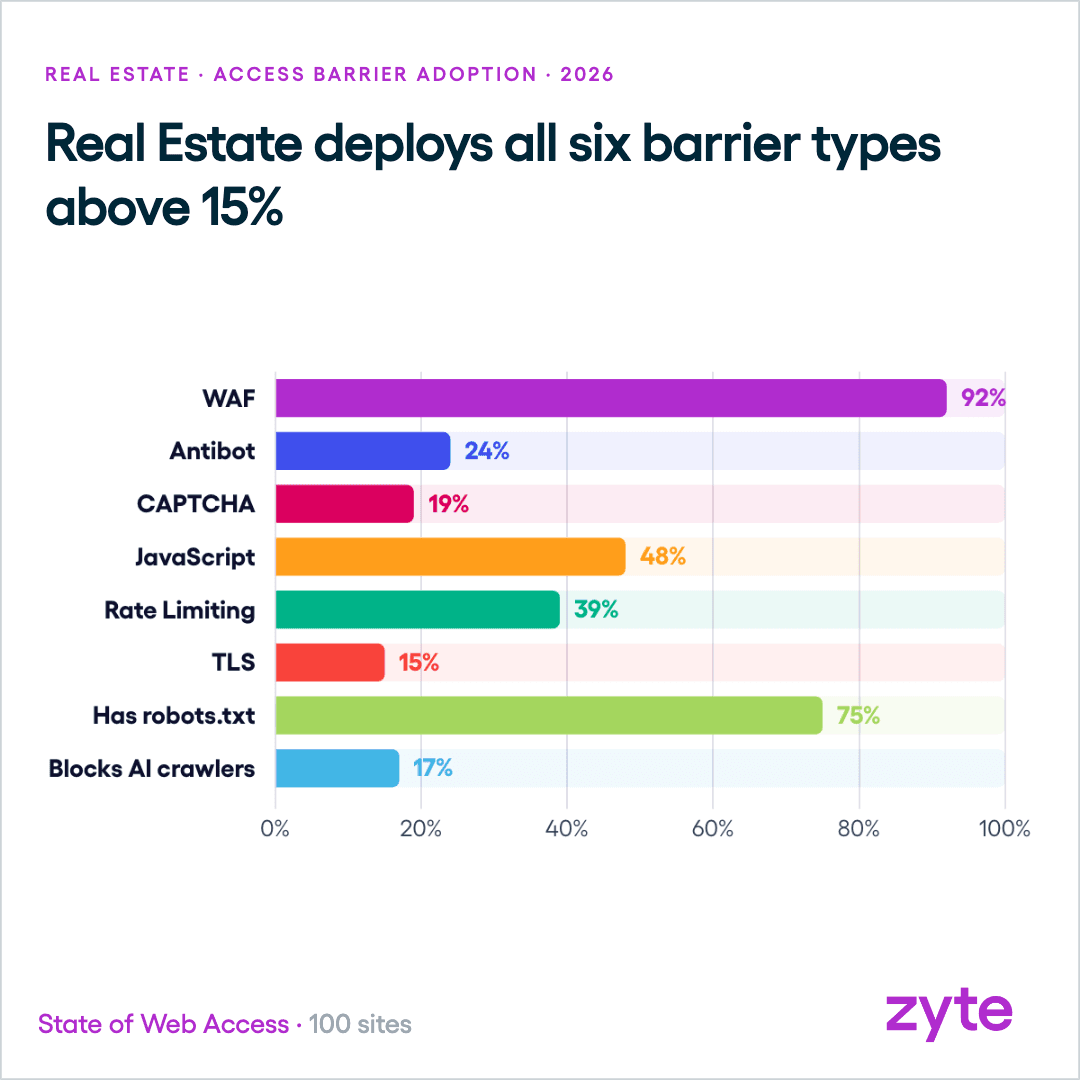
Real estate spreads its defenses across all six barrier types, each on more than 15% of sites, so there's no single tall wall to plan around.
| Barrier | Real estate sites | Research-wide average |
|---|---|---|
| Web application firewall | 92% | 92% |
| JavaScript | 48% | 41% |
| Rate limiting | 39% | 22% |
| Antibot | 24% | 19% |
| CAPTCHA | 19% | 23% |
| TLS | 15% | 14% |
A few patterns stand out:
- Rate limiting is the signature control. At 39%, real estate ranks seventh of 110 industries, level with furniture retail and behind only a handful of shopping sectors.
- JavaScript is required on almost half of sites, because modern property search runs as an application, with map views, filters and listing cards loaded after the page opens.
- CAPTCHA sits below the research-wide average. A property portal wants a browsing buyer to keep clicking through listings, and a challenge page on every search would drive them elsewhere.
Real estate rate limiters block on the first request
The way real estate uses rate limiting matters as much as how often. Of the 39 sites in the study that run a rate limiter, 38 returned a block on the very first automated request, almost always as a flat 403 Forbidden rather than a polite 429 Too Many Requests.
That's a rate limiter in name only: it judges the client on arrival, so slowing a crawler down won't change the outcome. The same first-request behavior shows up across the most defended parts of retail, as our analysis of rate limiting explains.
Most real estate sites stack three barriers
Three barriers at once is the most common setup in real estate, found on 31% of sites, and 46% of sites run three or more. That puts the sector eighth of 110 for layered defenses.
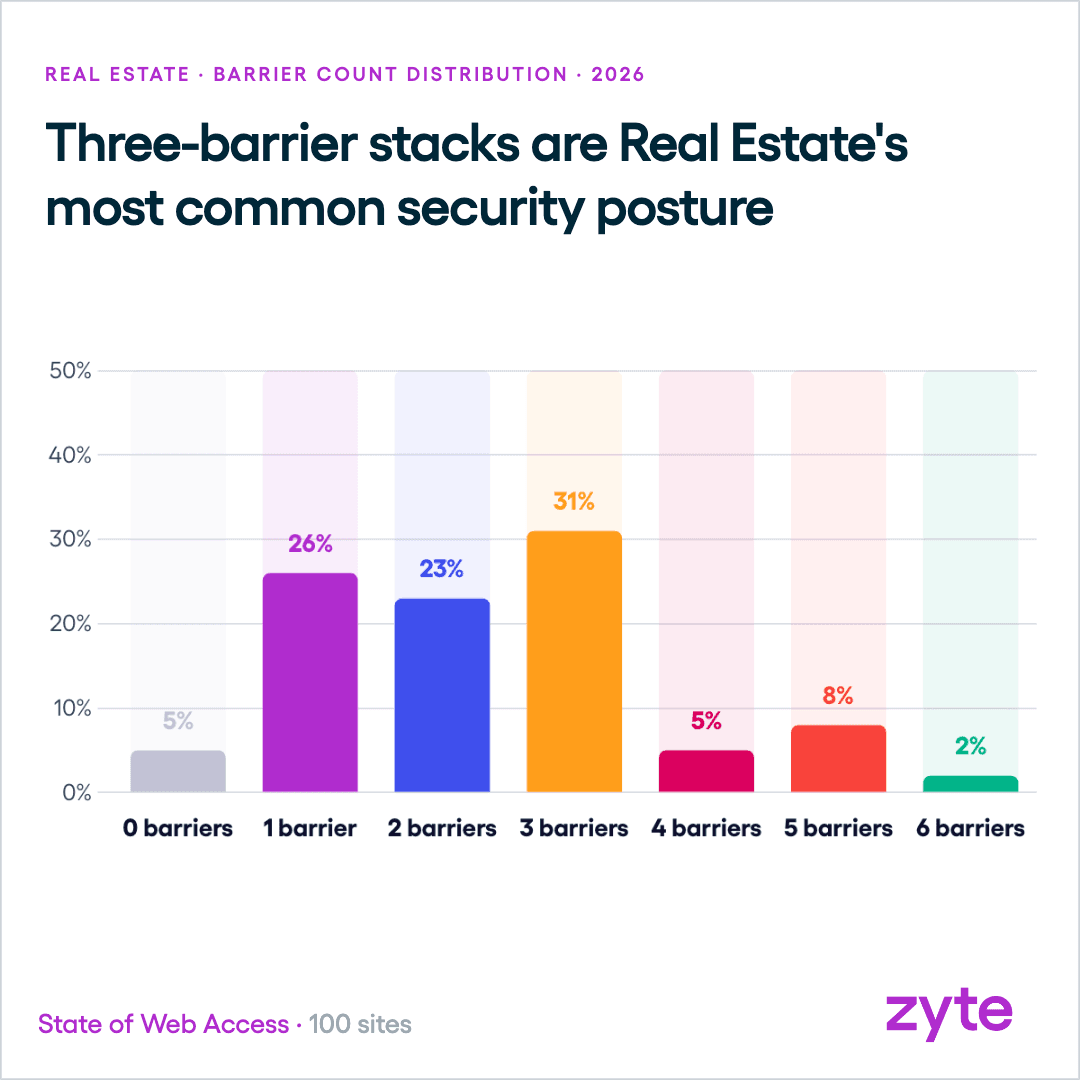
Stacking is what pushes a sector up the complexity scale. A firewall alone rarely stops anything, but a firewall plus JavaScript rendering plus a first-request rate limiter means a crawler has to handle the connection, the rendering and the request pattern all together, with no single fix that clears the way. How these combinations build on one another across the web is covered in our look at barrier stacking.
What does it cost to scrape a real estate site?
Zyte API's complexity tiers turn those barriers into infrastructure, and Zyte API's pricing follows the difficulty each site actually presents rather than charging a flat rate, so customers pay the lowest rate a site requires.
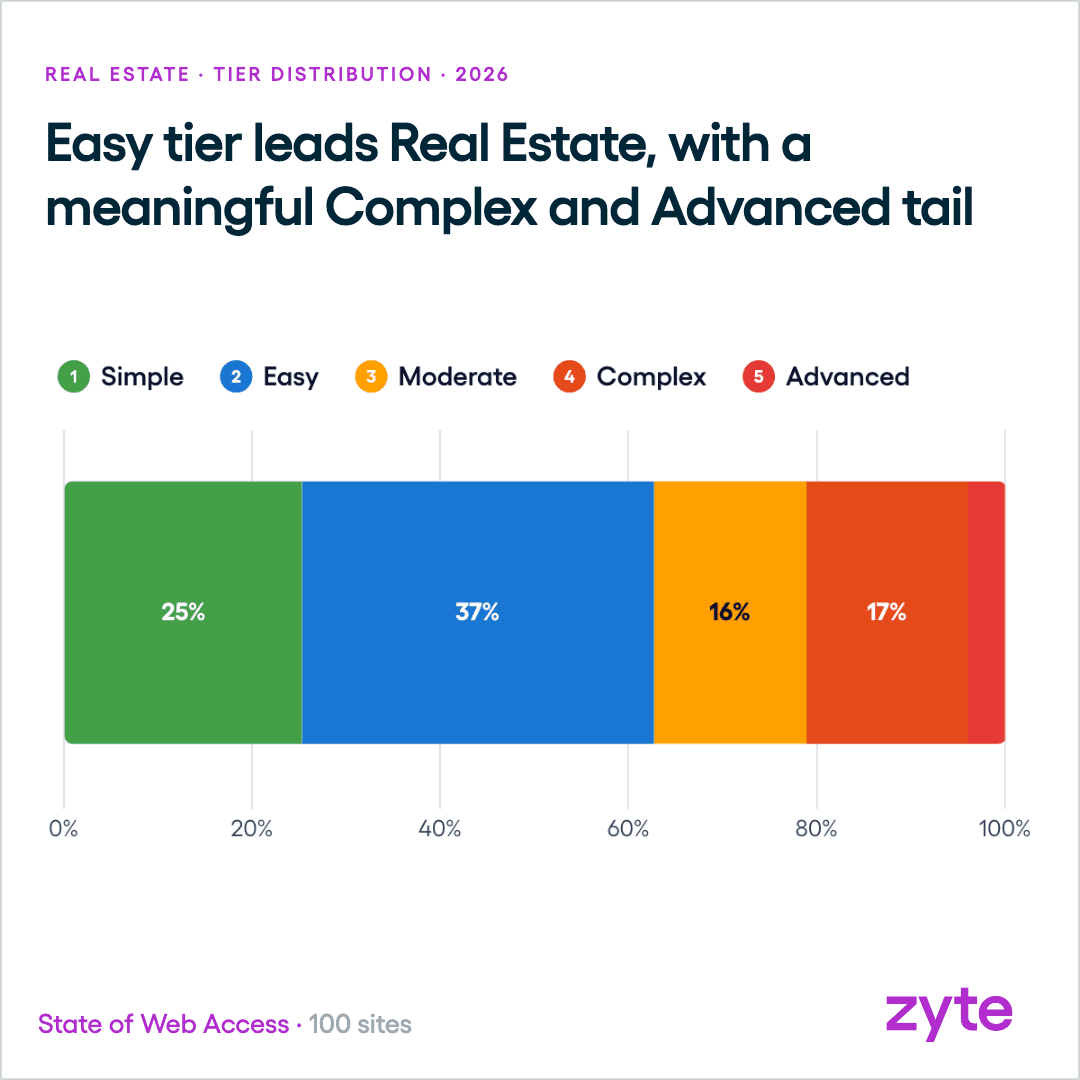
Easy is the most common outcome in real estate, covering 37% of sites, where a headless browser handles the job. A further quarter are Simple enough for a plain HTTP request.
The tail is where real estate earns its ranking:
| Access tier | Real estate sites |
|---|---|
| Simple | 25% |
| Easy | 37% |
| Moderate | 16% |
| Complex | 17% |
| Advanced | 4% |
More than one in five real estate sites rate Complex or Advanced, the tiers that call for residential proxies and heavier browser infrastructure. That's about five times the share across the whole web.
The biggest property portals defend the hardest
Traffic makes the split sharper. Divide the sector's 100 sites by visitor numbers and the busier half averages 2.67 on the complexity scale, against 2.08 for the quieter half.
| Measure | Busiest 50 sites | Other 50 sites |
|---|---|---|
| Mean access tier | 2.67 | 2.08 |
| Rate limiting | 52% | 26% |
| TLS | 24% | 6% |
| Three or more barriers | 50% | 42% |
The large portals and listing aggregators carry the heaviest controls, with rate limiting on half of them and TLS checks four times as common as among smaller sites. Individual agency and developer sites, which mostly want their handful of listings found, sit lower down the scale.
That fits the commercial picture. The listing feed is a portal's core asset, and the industry has spent the past two years fighting over it in court. In 2025 alone, a commercial property data company sued one of the biggest US home portals over tens of thousands of listing photos, and a separate antitrust suit challenged a regional listing service over who gets access to listing feeds at all.
How does real estate access vary by region?
Property is a local business, and the regional data shows how much harder local markets can be. Zyte measured the sites most visited from each country, so these figures describe the property sites people actually use in each region, which skew toward the big national portals.
| Region | Real estate sites rated Moderate or above | Rate limiting |
|---|---|---|
| Europe | 71% | 42% |
| Asia | 72% | 42% |
| South America | 68% | 42% |
| North America | 67% | 40% |
| Africa | 56% | 35% |
| Oceania | 40% | 31% |
Seven in 10 of the property sites most visited in Europe and Asia rate Moderate or harder to access, against roughly one in six of all sites in those same regions. In every region, real estate sits far above the local norm.
Oceania stands apart. Its most visited property sites are the most accessible anywhere, with 40% at Moderate or above, the lightest rate limiting, and the highest robots.txt coverage of any region at 83%. North America has the most JavaScript-heavy property sites, at 65%, and the lowest AI-block rate, at 16%.
For a data team, the practical point is that a global real estate project can't budget from a single country. A crawler built for the Australian market will meet a much tougher reception in Europe.
Real estate is split on AI crawlers
Real estate is more active on AI policy than most sectors. 17% of real estate sites name an AI crawler to block in their robots.txt, above the research-wide 11% and 17th of 110 industries, with GPTBot and ClaudeBot the most frequent targets.
But the sector is also unusually welcoming. In most industries, an AI crawler named in robots.txt is named to be shut out. In real estate, the same AI agents turn up in Allow rules almost as often as in Disallow rules, and 13 sites explicitly allow at least one.
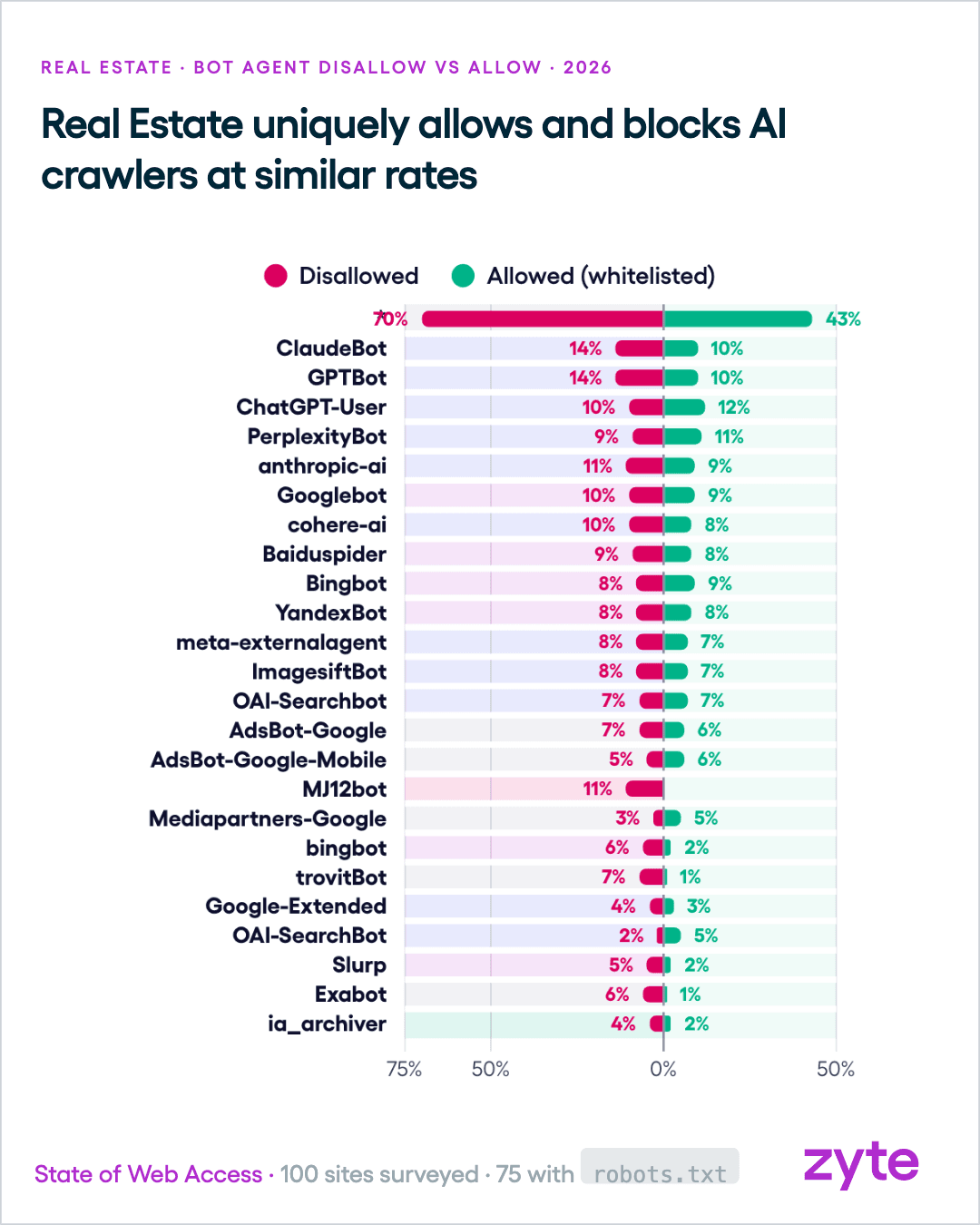
The balance tips slightly by type of agent. The assistants that fetch a page for a live user, such as ChatGPT-User and PerplexityBot, are allowed a little more often than they are blocked. The crawlers associated with model training, such as GPTBot and ClaudeBot, lean the other way.
The logic follows the listing. An agent wants a buyer who asks an AI assistant about homes in a neighborhood to see their property in the answer, but has less reason to let a model absorb the whole listing archive. Path-level rules, which open some parts of a site while closing others, dominate real estate's robots.txt files, and they let a site make exactly that kind of distinction.
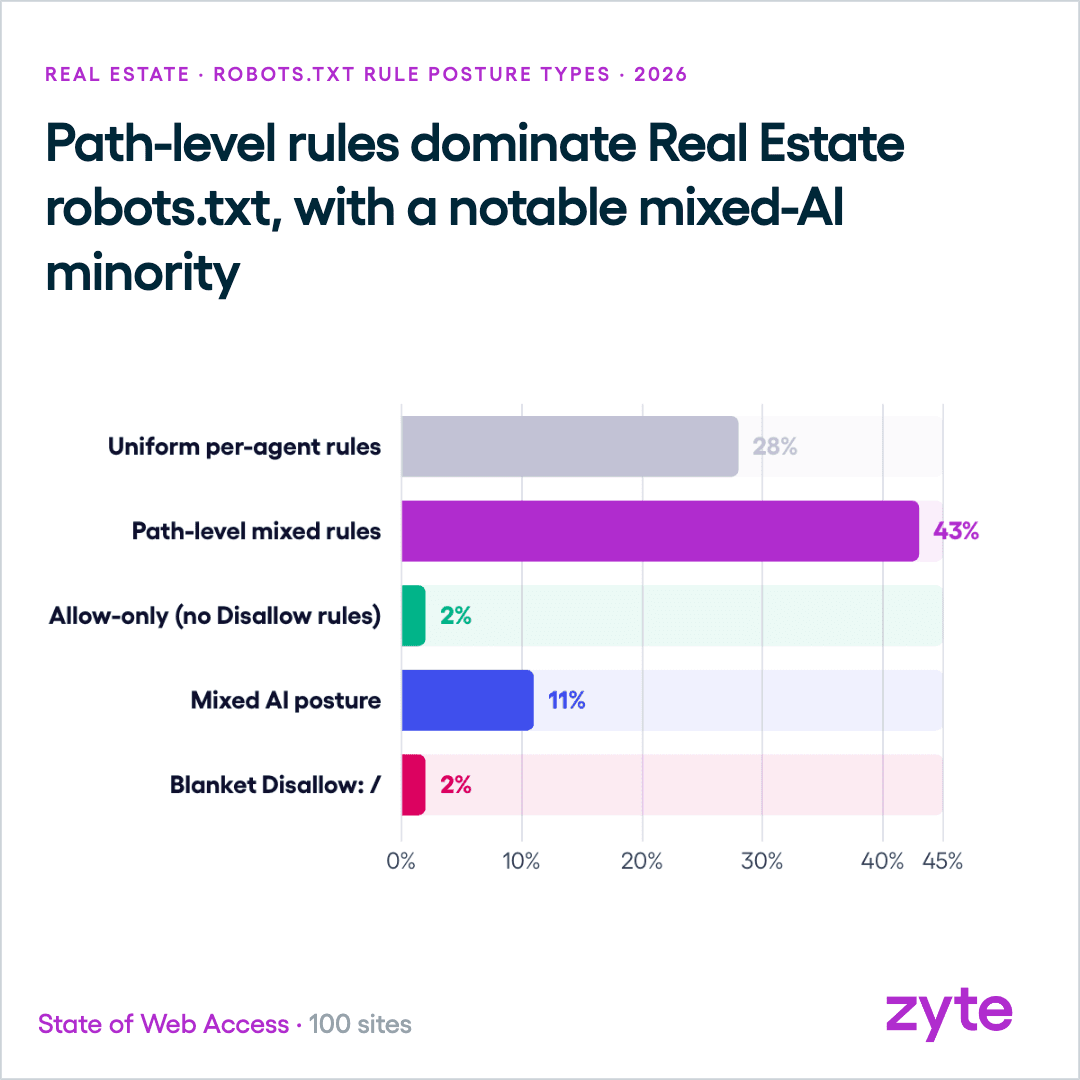
The robots.txt files also get long. A handful of large property sites name dozens of agents each, from SEO audit tools such as MJ12bot to property-specific aggregators, while the typical site names only two. The detailed rulebooks belong to the portals, matching the technical picture.
What this means if you work with real estate data
Property data feeds valuation models, rental market tracking, investment research and housing policy work, and most of it starts with publicly listed homes. For anyone collecting it at scale, the study suggests:
- Expect a full browser for most portals. JavaScript rendering is close to standard, and map-driven search pages load their listings after the page opens.
- Don't treat the rate limiter as a speed control. Real estate blocks on the first request, so throttling alone won't help.
- Budget by site size. The biggest portals are where Complex and Advanced tiers concentrate, and the agency long tail is far cheaper to reach.
- Plan regionally. Europe, Asia and South America run much harder than Oceania, and national portals tend to be harder than the global average suggests.
- Read the robots.txt closely. Real estate is one of the few sectors with an active, split AI policy, and its path-level rules can open one part of a site while closing another.
Real estate is built for exposure at the level of the single listing and for protection at the level of the market. The closer a site gets to owning that whole market picture, the harder it becomes to read.
Key takeaways: Real estate access, in five numbers
Outside retail and e-commerce, no industry on the web is harder to access at scale:
- 2.38 of 5 - real estate's mean access-complexity tier, fourth of 110 industries.
- 38 of 39 real estate rate limiters block on the first request.
- One in five real estate sites rate Complex or Advanced to access.
- 72% of the property sites most visited in Asia rate Moderate or above, against 40% in Oceania.
- 17% block AI crawlers in robots.txt, while some of the same sites welcome AI assistants in.